
Artificial Intelligence (AI) projects represent a massive opportunity for businesses across South Africa to reimagine operations, boost efficiency, and gain competitive advantage. However, the reality remains daunting: up to 60% of AI initiatives in enterprises worldwide fail to reach full deployment. For South African companies, this risk translates into significant financial losses, wasted resources, and missed opportunities , especially considering the unique challenges posed by local market conditions such as load-shedding, regulatory compliance under POPIA, and infrastructure constraints.
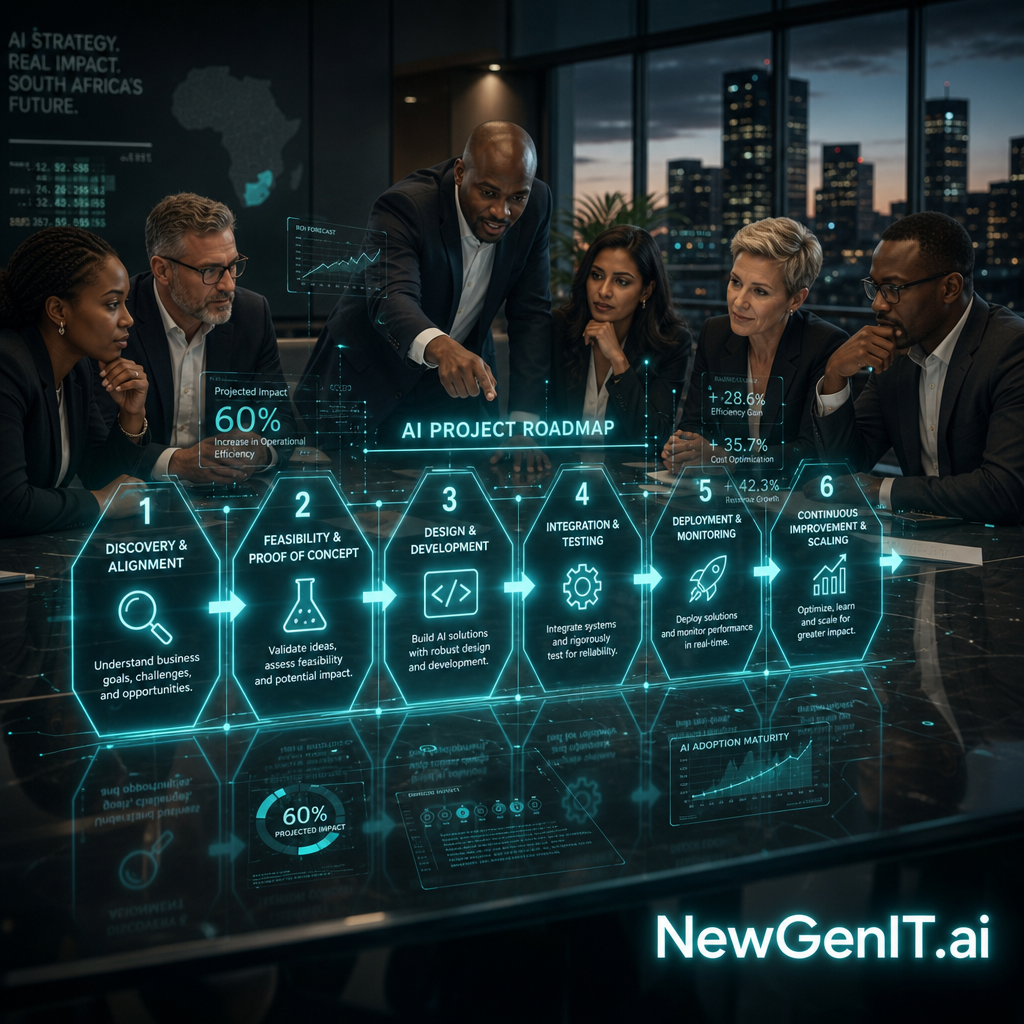
NewGenIT.ai has developed a disciplined, end-to-end six-phase methodology that addresses the root causes of AI project abandonment and ensures projects deliver tangible business value beyond proof-of-concept. This approach not only helps South African businesses overcome internal challenges but also adapts to the external realities faced by industries in Johannesburg, Durban, and Cape Town.
Understanding Why AI Projects Fail in the South African Context
The high failure rate of AI projects globally has roots in factors such as unclear strategic alignment, data quality issues, lack of stakeholder engagement, and insufficient change management. In South Africa, these obstacles are amplified by additional local realities:
- Load-Shedding Disruptions: Unscheduled power outages hinder infrastructure reliability and delay AI deployments that require consistent uptime.
- Data Privacy and POPIA Compliance: South Africa’s Protection of Personal Information Act (POPIA) mandates strict data governance, complicating data acquisition and model training phases.
- Skills Shortages: The scarcity of experienced AI engineers and data scientists affects project continuity and quality.
- Budget Constraints: Currency fluctuations and economic pressures limit investment and increase scrutiny over ROI.
Many organisations begin AI initiatives without a clear roadmap for overcoming these challenges, leading to scope creep, stalled development, and eventual project abandonment, and South African executives often feel the pressure of justifying ongoing spend in rand on projects that stall.
NewGenIT’s Six-Phase Methodology: A Structured Framework for Success
To counteract these risks, NewGenIT employs a six-phase methodology that guides AI projects from idea to scale with disciplined controls and ongoing stakeholder engagement.
1. Discovery & Alignment
This phase focuses on gaining a deep understanding of the specific business goals, challenges, and South African market conditions. It involves rigorous stakeholder consultation to achieve alignment across departments and leadership. In practice, this step may include workshops held in Sandton or Cape Town with senior executives to define AI use cases aligned to strategic objectives such as improving operational efficiency affected by power outages or optimising supply chain resilience.
2. Feasibility & Proof of Concept
Before committing large budgets, NewGenIT validates ideas through real-world feasibility assessments. For instance, data availability and quality are scrutinised with compliance experts to ensure POPIA adherence. A scaled-down prototype is developed to prove technical viability and measure preliminary impact, thereby de-risking the investment.
3. Design & Development
Using agile methodologies, AI solutions are developed with emphasis on scalability and integration readiness. Given the digital infrastructure variability across South Africa, models are designed to tolerate intermittent IT disruptions and localised data variations.
4. Integration & Testing
Seamless integration into existing business systems occurs here, with rigorous testing to verify accuracy, reliability, and security. Pilots may be deployed in regional hubs like Durban or Cape Town, where user environments differ, to ensure universal applicability.
5. Deployment & Monitoring
Rollout is controlled and includes continuous performance tracking against KPIs, such as operational efficiency improvements or cost reductions tracked in rand. Feedback loops allow identification of issues caused by external factors like load-shedding and rapid adaptation.
6. Continuous Improvement & Scaling
AI capabilities are optimised based on monitored data, and successful projects are scaled across business units. This phase ensures long-term value and adaptability to evolving conditions in South Africa’s dynamic market.
Practical Benefits and Quantifiable Impact
NewGenIT’s structured AI project roadmap has demonstrated measurable gains for South African clients, including:
- 60%+ Increase in Operational Efficiency: Through AI-driven automation and predictive maintenance, clients have overcome challenges related to power outages and resource inconsistencies.
- 28-35% Cost Optimisation: By closely aligning AI outcomes with business objectives and conducting proof of concept to validate technologies, organisations avoid costly project overreach.
- 42% Revenue Growth: Leveraging AI to enhance customer analytics and market penetration in competitive hubs like Sandton has driven new revenue streams.
These figures underscore the importance of disciplined project management to unlock AI’s potential while simultaneously navigating South African complexities.
Aligning AI Projects with POPIA and Local Regulations
One of the critical factors in AI project sustainability in South Africa is ensuring compliance with POPIA. NewGenIT embeds privacy and data protection protocols within each phase of its methodology. This includes:
- Conducting impact assessments during discovery to identify data sensitivities
- Implementing secure data handling practices during feasibility and development
- Auditing AI model outputs to prevent biased or unregulated data use
This approach not only ensures legal compliance but builds trust with customers and stakeholders in a market increasingly focused on ethical AI adoption.
Mitigating the Impact of Load-Shedding on AI Implementations
Power instability is a daily reality for many South African businesses. NewGenIT anticipates these challenges by designing AI infrastructures that incorporate:
- Resilient Cloud and Edge Computing: Hybrid cloud models reduce dependency on unstable local power for critical processing.
- Backup Systems and Failover Protocols: Ensuring AI services remain operational or degrade gracefully during outages.
- Data Synchronisation Mechanisms: Minimising data loss when connectivity drops.
Such safeguards are essential to maintain AI reliability and user confidence.
Practical Takeaways for South African IT Leaders and Decision-Makers
- Invest in Early Alignment: Engage business leaders and legal teams upfront to ensure AI initiatives meet strategic and regulatory requirements.
- Validate Before Scaling: Do not bypass feasibility and proof of concept stages even if competitive pressures mount.
- Design for Local Realities: Factor in unique infrastructural challenges like load-shedding at the design phase to build resilience.
- Implement Ongoing Monitoring: Establish clear KPIs linked to rand-based financial metrics and operational goals, regularly reviewing post-deployment success.
- Focus on Continuous Improvement: Treat AI adoption as a journey of evolution and learning, not a one-off project.
Conclusion: Unlocking AI’s Transformative Potential for Sustainable South African Growth
The promise of AI for South African businesses is immense, but realising that potential demands a methodical, contextualised approach that mitigates risks endemic to both AI adoption and local market conditions. NewGenIT’s proven six-phase methodology offers a robust roadmap from ideation through to scaled integration, ensuring South African enterprises convert AI initiatives from costly experiments into strategic assets.
By bridging the gap between technology and the realities of South Africa’s evolving economic landscape, this approach empowers CEOs, Managing Directors, and IT leaders to confidently embrace AI for long-term competitive advantage and operational excellence.
How is your organisation navigating the complexities of AI project implementation in South Africa? What strategies or lessons learned can you share that have helped ensure success? We invite you to join the conversation and share your insights below.