Here's a truth that doesn't make it into the sales pitch: the day your AI model goes live is the day the hard work actually starts. The launch is the easy part. It's the six months afterwards , when your data quietly shifts, when a supplier changes their invoice format, when load-shedding knocks out a pipeline at 2am , that separates AI projects that deliver value from the ones that get quietly switched off.
We see this pattern constantly with South African businesses. A team invests heavily in building a model, celebrates the deployment, and then treats it like a completed IT project , something that just runs. AI doesn't work that way. A deployed model is a living system that degrades if left alone. Managed AI operations exist to keep that system healthy, secure, and useful long after the launch confetti has been swept up.
So let's get specific about what that actually involves.
1. Performance Monitoring: Catching Drift Before It Costs You
Every AI model is trained on a snapshot of the world. The problem is that the world keeps moving. This is called model drift, and it's the single most common reason AI systems silently stop working.
Imagine a credit-scoring model trained on transaction data from 2022. By late 2024, consumer spending patterns have shifted, inflation has reshaped behaviour, and new payment methods have entered the market. The model doesn't crash , it just gets quietly, incrementally worse at its job. Nobody notices until a wave of bad decisions has already been made.
We monitor the metrics that matter:
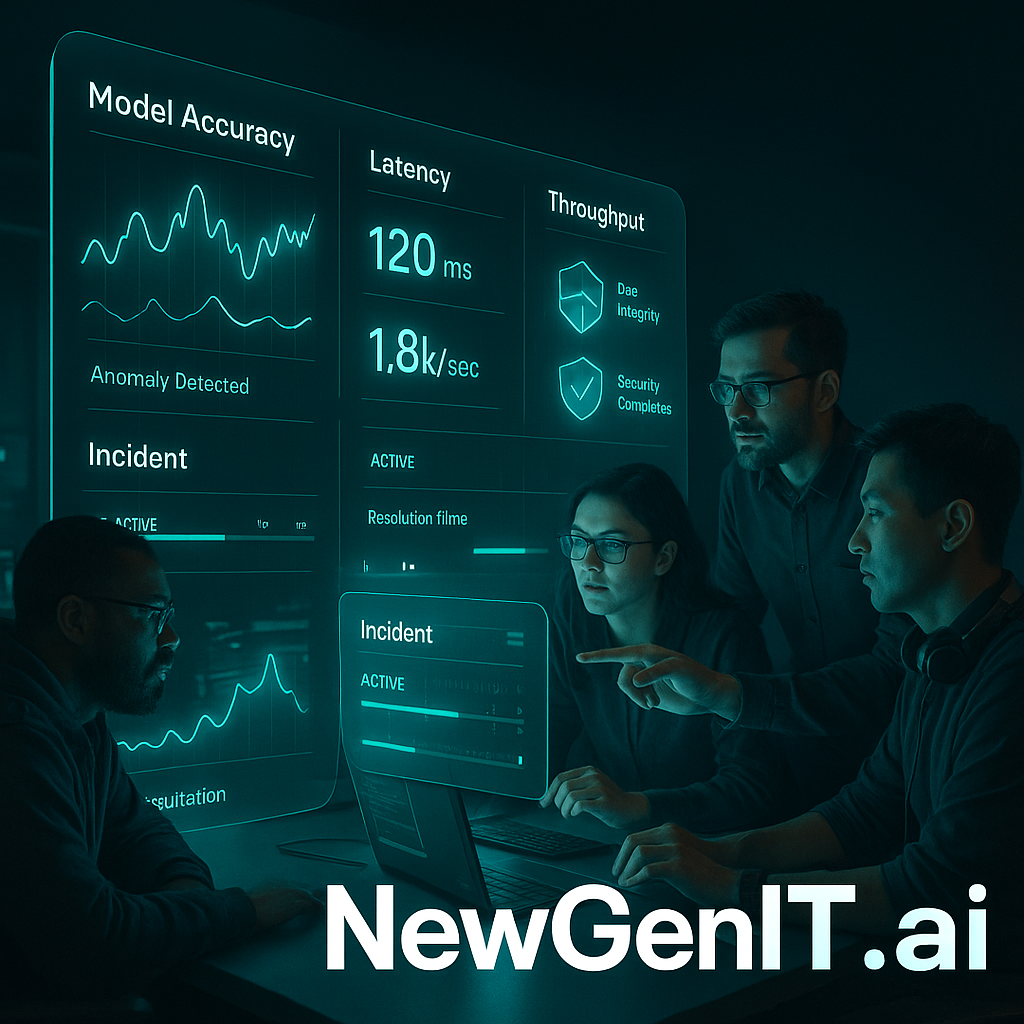
- Model accuracy , is the model still making correct predictions against real-world outcomes?
- Latency , how long does a prediction take? A recommendation engine that takes four seconds is a broken recommendation engine.
- Throughput , can the system handle peak load, like a retailer's month-end or a Black Friday spike?
- Data drift and concept drift , has the shape of your incoming data changed compared to what the model expects?
The point of continuous tracking isn't to generate dashboards nobody reads. It's to catch degradation while it's a small problem, not after it's become a business incident.
2. Data and Model Integrity: Garbage In, Bias Out
An AI model is only as good as the data feeding it. In production, that data is messy, unpredictable, and constantly changing. A single upstream system that starts sending dates in a different format, or a sensor that begins reporting nulls, can poison your model's outputs without triggering a single error message.
We monitor input data for anomalies , sudden spikes, missing fields, values outside expected ranges, distributions that don't match the training set. When the data tells us the model is no longer fit for purpose, we retrain it on fresh, validated data.
This is also where bias creeps in. A model that was fair at launch can develop skewed behaviour as its input data shifts. For any organisation making decisions that affect people , lending, hiring, insurance pricing , this isn't just a technical concern. It's a reputational and legal one. Ongoing integrity checks are how you keep an AI system accountable rather than assuming it stays accurate forever.
3. Security and Compliance: POPIA Doesn't Have a Grace Period
AI systems are a security surface like any other software , often a bigger one, because they touch large volumes of sensitive data and expose new attack vectors like prompt injection or model extraction.
For South African businesses, this is inseparable from POPIA. The Protection of Personal Information Act places firm obligations on how you collect, process, and store personal data , and an AI system that ingests customer information is squarely in scope. If your model is trained on personal data, you need to be able to answer hard questions: Who has access? Is data being minimised? Can you honour a data subject's request to delete their information from a system where it's been baked into a model?
Compliance is not a launch-day checkbox. Regulations evolve, your data footprint grows, and access needs change as staff come and go.
Our operational security work includes:
- Managing permissions and access controls so that only the right people and services touch the model and its data
- Conducting regular audits to catch drift in who has access and why
- Enforcing data privacy controls aligned with POPIA and relevant industry standards
- Monitoring for AI-specific threats that traditional security tooling often misses
4. Incident Management: When Things Break at 2am
They will break. A dependency will fail, an API will change, a data pipeline will stall, or , this being South Africa , the power will go out mid-batch and your model will resume with a corrupted state. The question is never if, but how fast you respond.
Load-shedding deserves a special mention here, because it's a uniquely local operational reality. An AI system that assumes constant uptime and clean, uninterrupted data flows is fragile in a Stage 6 environment. Good managed operations means building in resilience: graceful degradation, checkpointing, retry logic, and failover so that a two-hour outage doesn't cascade into a two-day recovery.
Our team actively monitors for operational anomalies and failures, with defined response processes to contain incidents quickly. The goal is to detect the problem before your users do , and to have a resolution path already mapped rather than improvised under pressure.
5. Reporting and Insights: Making the Invisible Visible
AI operations happen behind the scenes, which makes it dangerously easy for leadership to lose sight of what the system is actually doing. Transparent reporting fixes that.
We provide IT teams and decision-makers with clear, regular reporting on:
- Model performance trends over time , is it improving, holding steady, or slipping?
- Usage patterns , who's using the system, how often, and for what?
- Emerging issues and the actions taken to address them
- Cost and efficiency metrics, which matter enormously when inference costs are billed in dollars against a volatile rand
That last point is worth dwelling on. For South African businesses running AI on international cloud platforms, currency exposure is a real operational cost. A model that's inefficient in its resource usage doesn't just perform worse , it burns rand faster. Good reporting surfaces these trade-offs so you can make informed decisions instead of getting surprised by the invoice.
Why This Frees Your Team, Not Replaces It
The strongest argument for managed AI operations isn't the technical monitoring , it's what it lets your people do instead. Most in-house IT and data teams are stretched thin. Asking them to also carry 24/7 model monitoring, retraining cycles, compliance audits, and incident response means one of two things happens: either those tasks get neglected, or your best engineers get pulled off strategic work to firefight.
When we handle the day-to-day lifecycle complexity, your team gets to focus on the things that actually move the business forward , new use cases, deeper integration, and strategy , rather than babysitting infrastructure.
The numbers back this up. Gartner's 2024 research found that organisations investing in managed AI operations see up to a 30% increase in AI-driven business value. That's not because the AI is smarter , it's because a well-operated system stays accurate, stays trusted, and stays running.
The Takeaways
- Deployment is the starting line, not the finish line. A model left unattended will degrade , the only question is how fast.
- Drift is inevitable. Continuous performance and data monitoring is how you catch it before it costs you customers or credibility.
- Compliance is ongoing. POPIA obligations don't pause after launch, and your access and data footprint change constantly.
- Build for local reality. Load-shedding resilience and rand-aware cost management aren't optional extras in South Africa , they're core to keeping AI viable.
- Visibility drives value. Clear reporting turns AI from a black box into a decision-making asset.
If your AI system is already live, ask yourself an honest question: do you actually know how it's performing right now? If the answer involves a shrug, that's exactly the gap managed operations is built to close.
How is your team currently handling post-deployment AI operations? We'd genuinely like to hear where the pain points are , whether it's drift, compliance, uptime, or just finding the time. Get in touch with NewGenIT.ai to talk through what managing your AI lifecycle could look like.