Most AI projects in South Africa die in one of two places: the proof-of-concept graveyard, where a slick demo never survives contact with real data, or the maintenance swamp, where a working system slowly rots because nobody documented how it was built. Both failures share a root cause , there was no methodology, just enthusiasm and a deadline.
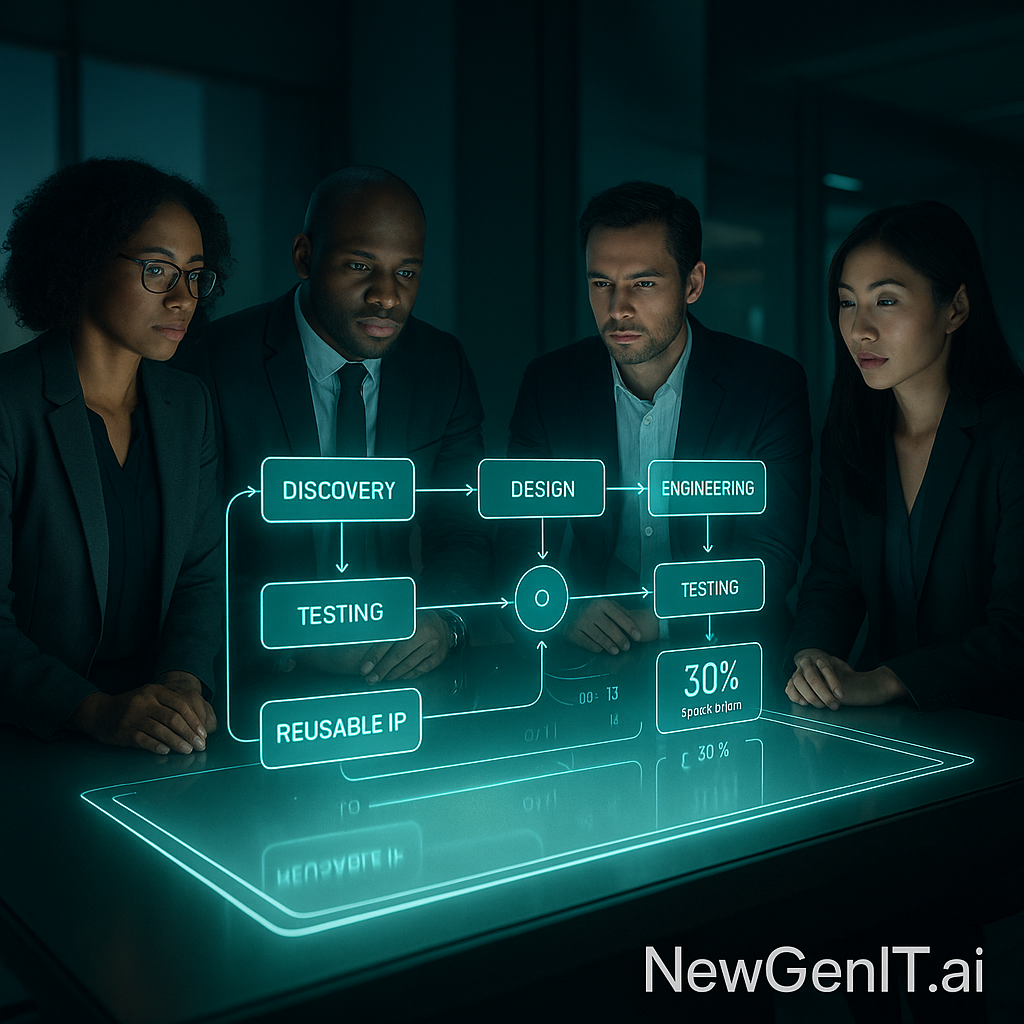
At NewGenIT.ai we work as Forward Deployed AI Engineers, which means we embed with a business, understand its actual operations, and build systems that ship. Over dozens of engagements we've hardened a 6-phase FDE methodology , Front-to-Back Discovery, Design, and Engineering. It's not a framework we invented to sound impressive on a slide. It's the sequence that consistently gets a solution from "wouldn't it be nice if" to "this is running in production and paying for itself." Here's how it works, and why the last phase , reusable IP , is the one that quietly compounds into real competitive advantage.
Why a Methodology Beats Heroics
The South African tech landscape has a particular flavour of chaos. You're building systems that need to survive load-shedding, comply with POPIA, run on infrastructure priced in rands but often billed in dollars, and integrate with legacy enterprise systems that were last touched during the Zuma administration. In that environment, relying on a talented engineer's gut instinct is a gamble.
A structured approach does something boring but powerful: it makes success repeatable. When every project follows the same disciplined arc, you stop re-solving problems you've already solved. Industry data backs this up , organisations using structured development frameworks report up to a 30% reduction in development cycle times and materially higher adoption rates once systems go live. Faster and stickier. That's the whole game.
Let's walk through the six phases.
Phase 1 & 2: Discovery and Design , Getting the Problem Right
Discovery is where most of the value is won or lost, and it's the phase everyone wants to rush. We don't. Before writing a line of code, we sit inside the business and map how work actually happens , not how the org chart says it happens.
Consider a typical scenario: a distributor tells us they want "an AI to handle customer queries." Discovery reveals that 60% of those queries are actually stock availability checks that could be answered by exposing existing ERP data, and only a fraction genuinely need a language model. Discovery turned an expensive AI project into a cheaper, faster integration project with a small AI layer on top. That reframing is worth more than any model.
Design then takes those findings and architects for the real world. In South Africa that means:
- Resilience to intermittent connectivity and power , systems that queue, retry, and degrade gracefully rather than falling over during Stage 6.
- POPIA-conscious data flows , deciding early where personal information lives, who touches it, and whether data leaves the country.
- Rand-aware cost modelling , choosing between cloud inference, self-hosted models, and hybrid setups based on what the numbers actually look like at scale, not what's trendy.
A good design is one you can hand to a stranger who then understands not just what you built, but why every significant decision was made.
Phase 3 & 4: Engineering and Validation , Building It to Last
Engineering is where the plan becomes software. The discipline here is resisting the temptation to over-build. We ship the smallest thing that solves the real problem, then iterate. AI systems especially reward this , you learn more from one week of real usage than from three months of speculative feature-building.
Then comes the phase that separates professionals from demo-merchants: testing and validation. AI systems fail in ways traditional software doesn't. A model that scored 95% on your test set can behave erratically on live South African data , local names, mixed-language input, formats and edge cases no overseas benchmark ever anticipated.
A demo proves something can work once. Validation proves it works reliably, on your data, under your load, when you're not watching.
Our validation covers accuracy against real production data, behaviour under load-shedding-induced failures, security and privacy compliance, and , critically for anything AI-driven , guardrails against the model doing something confidently wrong. This is the phase that lets you sleep at night after go-live.
Phase 5: Deployment , The Unglamorous Discipline
Deployment excellence is mostly about what doesn't happen. No 2 a.m. panic. No "it worked on my machine." No surprise cloud bill at month-end.
We treat deployment as its own engineering problem: monitoring so you know when something drifts, rollback paths so a bad release isn't a catastrophe, and integration that fits into the client's existing systems rather than demanding they rebuild around us. For a distributor, smooth deployment means faster time-to-market , the solution starts generating value in weeks, not quarters. And because the earlier phases were done properly, deployment is rarely the dramatic event people fear. It's an anticlimax, which is exactly what you want.
Phase 6: Reusable IP , Where the Compounding Happens
This is the phase that most consultancies skip, and it's the one that changes the economics of everything.
Every engagement produces more than a working system. Done deliberately, it produces reusable intellectual property , the connectors, prompt architectures, data-cleaning pipelines, POPIA-compliance patterns, and deployment scaffolding that solved this problem and will solve the next one faster.
Here's the difference in practice. The first time you build a POPIA-compliant document-processing pipeline, it takes weeks and a lot of hard thinking. The second time, you assemble it from proven components in days. The third client gets a battle-tested asset at a fraction of the cost and risk. For a distributor, this is the flywheel:
- Time-to-market keeps shrinking as your library of proven assets grows.
- Quality goes up, not down, because each component has been hardened across multiple real deployments.
- You differentiate on capability, offering things competitors would have to build from scratch.
Reusable IP is how a services relationship turns into a genuine competitive moat. Instead of selling the same effort repeatedly, you build a growing asset base that makes every future project cheaper, faster, and more reliable than the last.
Takeaways
If you're evaluating how to bring AI and modern engineering into your organisation, a few points are worth carrying with you:
- Spend disproportionately on Discovery. The most expensive mistakes are the ones where you built the wrong thing beautifully.
- Design for South African reality , power, connectivity, POPIA, and rand economics are not edge cases here, they're the baseline.
- Never confuse a demo with a validated system. The gap between them is where budgets and reputations go to die.
- Insist on reusable IP. Ask any partner what you'll own and can reuse after the engagement ends. If the answer is "nothing", you're renting outcomes forever.
A methodology isn't bureaucracy , it's the accumulated scar tissue of every project that taught you a lesson. The NewGenIT 6-phase FDE approach exists to make sure you only learn each lesson once, and then profit from it on every project that follows.
How is your organisation approaching AI and product development? Are you building reusable assets, or rebuilding from zero every time? We'd genuinely like to hear where you're landing on this.