Artificial Intelligence (AI) adoption is no longer a futuristic concept limited to global tech giants or Silicon Valley startups. For South African enterprises, be it in bustling Sandton, thriving Durban, or innovative Cape Town, AI promises transformative business value. Yet for many CFOs and IT leaders, the road from AI curiosity to meaningful impact is fraught with uncertainty, high investment costs, and risks borne from misaligned projects.
NewGenIT, a South African forward-deployed AI engineering firm, has pioneered a disciplined approach that mitigates these risks by performing an Operational AI Discovery before any AI development begins. This detailed phase identifies where AI can truly deliver the highest value, maximising returns and reducing wasted investment. Below, we unpack how this method works, why it matters in the South African context, and what it means for CFOs and business leaders striving for real digital transformation.
Why Many AI Projects Fail to Deliver in South Africa
South Africa’s economic and technological landscape presents unique challenges for AI implementation. With persistent issues like load-shedding interrupting operations and stringent data privacy laws such as POPIA requiring careful handling of personal data, enterprises must be cautious where they place their AI bets.
Moreover, South African CFOs often grapple with budget constraints exacerbated by rand volatility and inflationary pressures. Developing AI solutions without a clear roadmap can result in projects that are either technically unfeasible or offer marginal business impact, leading to sunk costs with little to show.
Take a medium-sized manufacturer in Gauteng, for example. Imagine investing R5 million in an AI system built to optimise supply chain logistics, only to discover after deployment that data quality is too poor or key operational bottlenecks haven’t been addressed. In such cases, the financial and reputational cost can be severe.
What is NewGenIT’s Operational AI Discovery Process?
The Operational AI Discovery is a front-loaded, rigorous assessment process. Rather than jumping into AI development, NewGenIT first conducts a holistic diagnostic of the client’s operational landscape, combining data analytics with stakeholder interviews across departments.
This approach maps workflows, identifies inefficiencies, and reviews existing data infrastructures. The goal is to pinpoint specific operational challenges where AI has a clear path to add value, balancing the business’s strategic goals with technical feasibility and local regulatory requirements such as POPIA compliance.
For instance, a Cape Town-based financial services firm might struggle with high manual fraud detection costs. The discovery process would assess data availability, workflows, and risk exposure, identifying whether AI could automate detection and reduce false positives, ultimately saving millions in operational expense.
Financial Impact: Up to 30% Cost Savings and Accelerated Time-to-Value
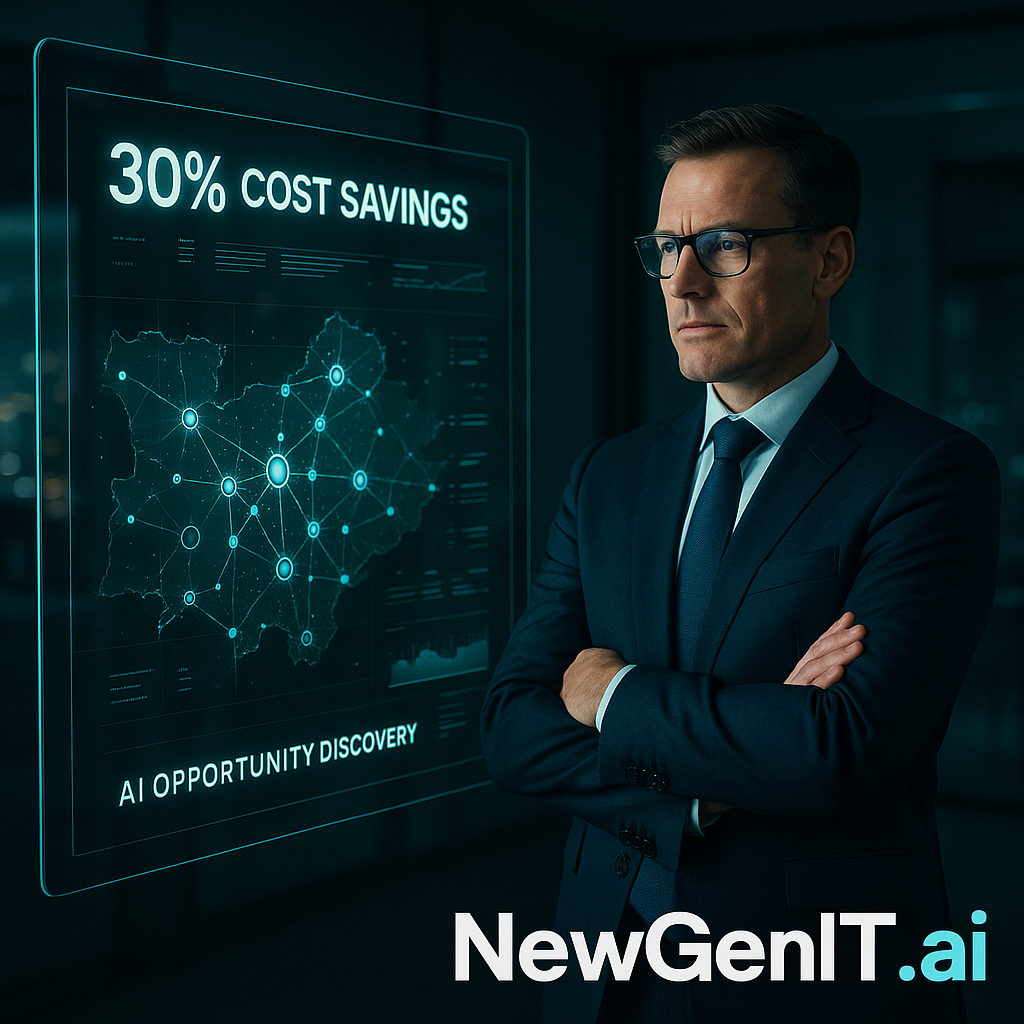
One of the most compelling benefits for CFOs is the measurable cost efficiency this discovery process drives. NewGenIT reports that organisations engaging in this early-stage discovery save up to 30% on project costs compared to typical AI initiatives.
Consider the following example: a Durban-based logistics company aiming to implement predictive maintenance on its vehicle fleet. Without discovery, unforeseen data issues or unclear objectives might inflate development costs by 40%. After discovery, the AI solution can be precisely scoped with realistic success criteria, improving budgeting accuracy and reducing overhead.
Furthermore, accelerated time-to-value means AI projects move from concept to operational impact faster. In a South African context, where operational agility can mitigate risks from power disruptions or supply chain volatility, this speed is crucial.
Aligning AI with Strategic Business Goals
South African enterprises need AI solutions that support long-term strategies, not short-lived technological experiments. NewGenIT’s discovery process ensures AI initiatives align with overriding business objectives, whether that’s improving customer experience, enhancing operational efficiency, or driving innovation.
For example, a retail chain in Sandton may seek to increase customer retention through personalised marketing. By mapping customer data flows during the discovery phase and integrating POS data with loyalty programmes, NewGenIT can reveal AI use cases that directly boost revenue rather than isolated pilot projects.
This strategic alignment also aids CFOs in justifying AI budgets with clear expected ROI, a critical factor for investment committees in South Africa’s economic climate.
Managing Risks and Ensuring Compliance in South Africa
Data privacy and ethical use of AI are paramount concerns for South African businesses, governed under the Protection of Personal Information Act (POPIA). NewGenIT’s discovery phase evaluates compliance requirements up front, embedding privacy-by-design principles into AI projects.
Moreover, South Africa’s frequent power interruptions demand robust, resilient AI systems. The discovery process factors in infrastructure limitations, recommending solutions that are energy-efficient or architected for intermittent connectivity. This ensures AI applications remain reliable even during load-shedding periods.
Practical Steps for CFOs and IT Leaders in South Africa
- Initiate an AI Opportunity Discovery: Invest time and resources up front to map your operational landscape and identify specific AI use cases tailored to your business realities.
- Engage Cross-Functional Teams: Include stakeholders from IT, operations, finance, and compliance to gather comprehensive insights and foster buy-in.
- Evaluate Budget Realistically: Use discovery findings to create an AI project budget with built-in contingencies that reflect complexity and local conditions like data quality.
- Prioritise Compliance: Ensure data governance and POPIA compliance are embedded in AI solution designs from the start.
- Monitor Time-to-Value: Track project milestones against anticipated ROI to confirm AI initiatives deliver results on schedule.
Conclusion: Transform AI from Speculative Cost to Strategic Asset
The journey to unlocking AI’s true potential in South Africa requires more than just cutting-edge technology, it demands a disciplined discovery process that uncovers high-impact opportunities aligned with your organisation’s unique operational realities. NewGenIT’s Operational AI Discovery equips CFOs and IT leaders with clarity, control, and confidence to make data-driven AI investments.
By reducing costs up to 30%, accelerating time-to-value, and ensuring compliance with POPIA and resilience against load-shedding, this approach transforms AI from a speculative expense into a targeted, high-value business investment.
How is your organisation currently identifying and prioritising AI opportunities? Would incorporating a structured discovery process like NewGenIT’s change your approach to AI investments and digital transformation?