In the dynamic and competitive business environment of South Africa, IT leaders face continual pressure to harness cutting-edge technologies for business growth and operational efficiency. Among these technologies, Artificial Intelligence (AI) emerges as a pivotal enabler, capable of unlocking insights and automating processes that catalyse competitive advantage. However, the traditional AI adoption journey is often slow, fragmented, and fraught with barriers ranging from data readiness to scalable deployment.
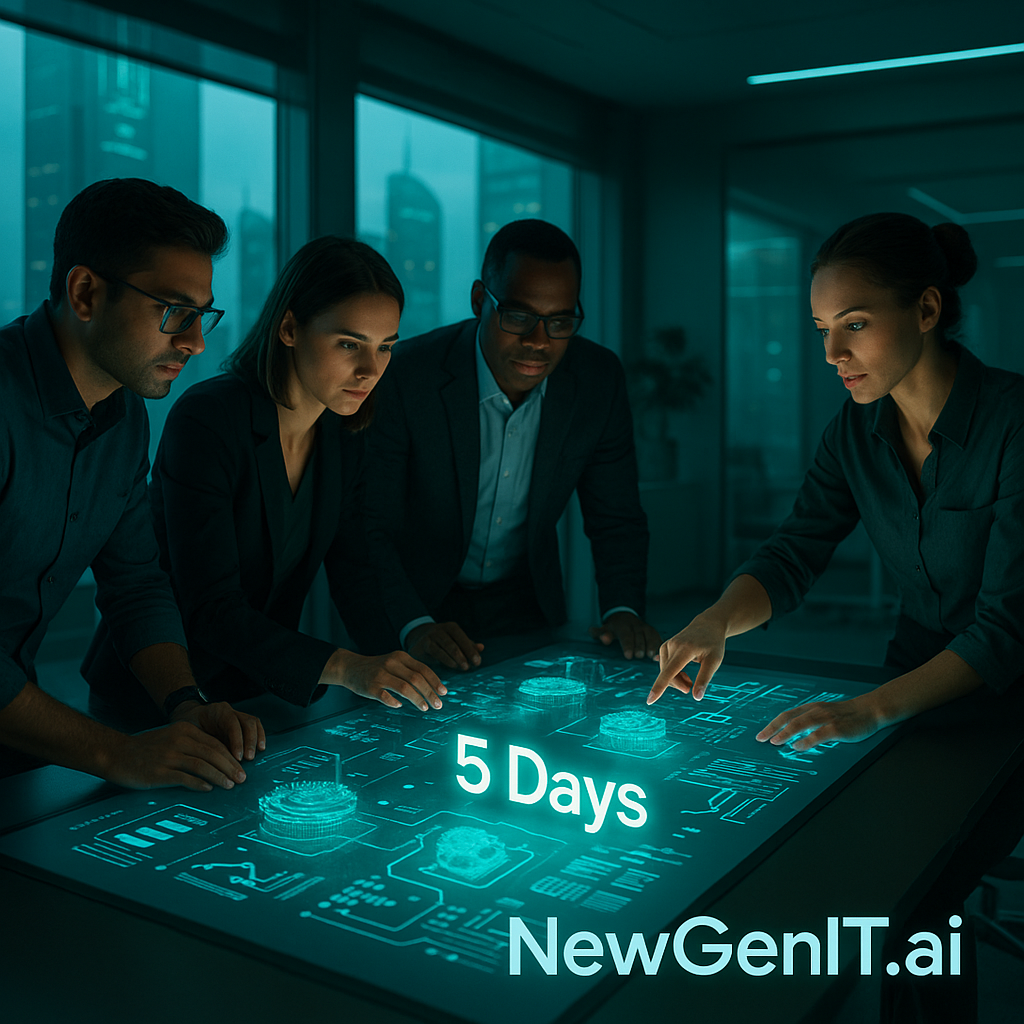
This is where the NewGenIT AI Impact Sprint comes in, a focused, hands-on program designed to compress months of AI development into an intensive 5-day cycle. Using real enterprise data, the sprint creates a fully operational AI system and deploys it directly into production, enabling South African organisations to accelerate AI innovation with measurable results.
Why South African Enterprises Need Accelerated AI Deployment
South Africa’s economic and technological landscape presents unique challenges and opportunities for AI adoption. Persistent issues such as load-shedding disrupt operations, while stringent data privacy laws like POPIA mandate careful management of personal data. Business hubs such as Sandton, Cape Town, and Durban are vibrant centres of commerce, but face intense pressure to innovate quickly.
Many organisations are uncertain about how to swiftly move from AI concepts to real-world applications. Traditional AI projects can stall due to:
- Long development cycles: Months or even years of experimentation and model tuning before deployment.
- Data quality and readiness issues: The need to prepare and interpret large datasets that may be incomplete or siloed.
- Compliance hurdles: Ensuring AI solutions conform to data protection regulations such as POPIA.
- Cost concerns: Prolonged projects often demand extensive budget allocations, which can be difficult in a constrained economy.
By accelerating this process, the AI Impact Sprint addresses these pain points directly, enabling organisations to realise value rapidly without compromising compliance or quality.
How the AI Impact Sprint Works: A Detailed Breakdown
The NewGenIT AI Impact Sprint is a highly structured, collaborative programme that focuses on validation, model development, and deployment over five consecutive business days. A typical engagement includes:
- Day 1: Discovery and Data Alignment , Expert teams work alongside client IT and business stakeholders to assess the quality and scope of existing enterprise data. Priority use cases are identified based on business impact and data viability.
- Day 2-3: Model Development and Iteration , With access to real data, AI engineers rapidly build and iterate machine learning models tailored to the selected use cases. Leveraging advanced frameworks and cloud or on-premise infrastructure, models are optimized for performance and compliance.
- Day 4: Testing and Validation , Comprehensive testing ensures the model operates accurately across edge cases, and meets POPIA compliance requirements around data access and processing.
- Day 5: Deployment into Production , The AI system is integrated into the client’s environment, whether in Sandton’s financial services sector or manufacturing in Gauteng, delivering actionable insights or automation capabilities immediately.
This compressed cycle eliminates months of slow experimentation, allowing organisations to begin capturing AI-driven ROI within a single working week.
The Tangible Business Benefits for South African Enterprises
Organisations that operationalize AI quickly gain significant competitive advantages. For example, according to McKinsey & Company, early adopters of AI enjoy up to a 20% productivity increase and a notable boost in profitability.
Concretely, enterprises in South Africa can expect benefits including:
- Improved decision-making: AI models provide real-time predictive analytics to support strategic and operational decisions, essential in volatile markets and resource-constrained contexts like South Africa.
- Operational efficiency: Automation of manual tasks reduces human error and accelerates workflows, critical when managing disruptions such as load-shedding.
- Cost savings: Faster AI realization shortens time-to-value, reducing project costs measured in Rand, and freeing capital for other investments.
- Regulatory compliance: Tailored AI solutions respect POPIA and other local regulations, mitigating legal risks.
Real-World Example: Financial Services in Sandton
Consider a mid-sized fintech company based in Sandton aiming to improve fraud detection with AI. Traditionally, building fraud detection AI models could take 3-6 months with multiple vendor engagements and uncertain outcomes.
By partnering with NewGenIT for an AI Impact Sprint, the company provided transaction data on Day 1, collaboratively defined fraud detection metrics, and by Day 5, had a model operationally integrated with their transaction monitoring system. The AI flagged suspicious transactions with over 85% accuracy, enabling the compliance team to proactively investigate cases and reduce financial losses by an estimated 15% within the first quarter.
This rapid turnaround contrasts sharply with conventional project timelines and underscores the value of real data-driven AI in production environments.
Addressing South African Market Realities: Infrastructure and Talent
South Africa’s technological infrastructure varies significantly between urban centres and rural areas. Businesses in metro hubs like Cape Town or Durban benefit from robust internet connectivity but must still navigate challenges such as intermittent power supply and bandwidth constraints.
NewGenIT’s AI Impact Sprint is designed with these realities in mind:
- Hybrid deployment strategies: Combining cloud services with on-premise processing to reduce reliance on unstable connectivity.
- Data security and privacy: Strong emphasis on encryption, anonymisation, and compliance alignment, critical under POPIA.
- Local expertise: Leveraging South African AI engineering talent who understand the regional business environment, culture, and regulatory landscape.
Practical Takeaways for IT Leaders and Decision Makers
The AI Impact Sprint is not a cookie-cutter solution but a tailored accelerator. South African IT leaders and business decision-makers should consider these points when planning AI initiatives:
- Engage with real data early: Synthetic or sample data can impede model accuracy and relevance. Prioritise projects with clean or improvable enterprise data.
- Align AI efforts with strategic business priorities: Focus on use cases that directly impact revenue, compliance, or operational resilience.
- Ensure cross-functional collaboration: Break down silos between data scientists, engineers, and business units for clearer objectives and faster iterations.
- Plan for production deployment: AI projects must transition rapidly from prototypes to integrated systems to realise benefits under operational constraints like load-shedding.
By adopting the AI Impact Sprint approach, South African enterprises can gain a strategic edge through fast, practical, and compliant AI innovation.
Conclusion: Accelerate Your AI Journey with NewGenIT
The NewGenIT AI Impact Sprint empowers South African organisations, from financial services and manufacturing to retail and healthcare, to transform their data assets into actionable AI capabilities rapidly. In a market where time-to-insight is vital, this 5-day program breaks traditional barriers, delivering AI value aligned with local market needs and compliance frameworks.
South African IT leaders and decision-makers stand at a crossroads. Will you take the step to accelerate your AI adoption journey and unlock tangible benefits in under a week?
We invite you to share your experiences or questions: How is your organisation accelerating AI projects from concept to production? What challenges or successes have you encountered along this path?