Here's a hard truth that most AI vendors won't tell you before you sign: the demo that wowed your executive team is the easiest part of the entire journey. Getting a model to work in a controlled sandbox is a solved problem. Keeping it accurate, compliant, secure, and cost-effective eighteen months later , while your data shifts, your regulations tighten, and your load-shedding schedule wreaks havoc on uptime , that's where the real engineering lives.
At NewGenIT.ai, we spend most of our time in that "after go-live" territory. It's less glamorous than the launch, but it's where AI either quietly delivers value or quietly rots. This post breaks down exactly what Managed AI Operations means in practice: what we monitor, what we maintain, and what we report back to your IT team every single week.
Why "Live" Is the Starting Line, Not the Finish
Traditional software is largely deterministic. You ship a payroll system, it calculates the same way in January as it does in December. AI systems are different. They're trained on a snapshot of reality, and reality keeps moving.
Consider a South African retail bank that deploys a credit-scoring model trained on 2023 data. By mid-2024, interest rates have shifted, consumer spending patterns have changed, and a new cohort of customers is applying. The model doesn't "know" any of this. It keeps making confident predictions based on a world that no longer exists. This is model drift, and it's silent , there's no error message, no crash, just slowly degrading decisions that cost money and erode trust.
The same applies to a fraud-detection system, a customer-support chatbot, or a demand-forecasting model. Without active management, every AI system trends toward irrelevance. Managed AI Operations exists to reverse that trend.
What We Monitor
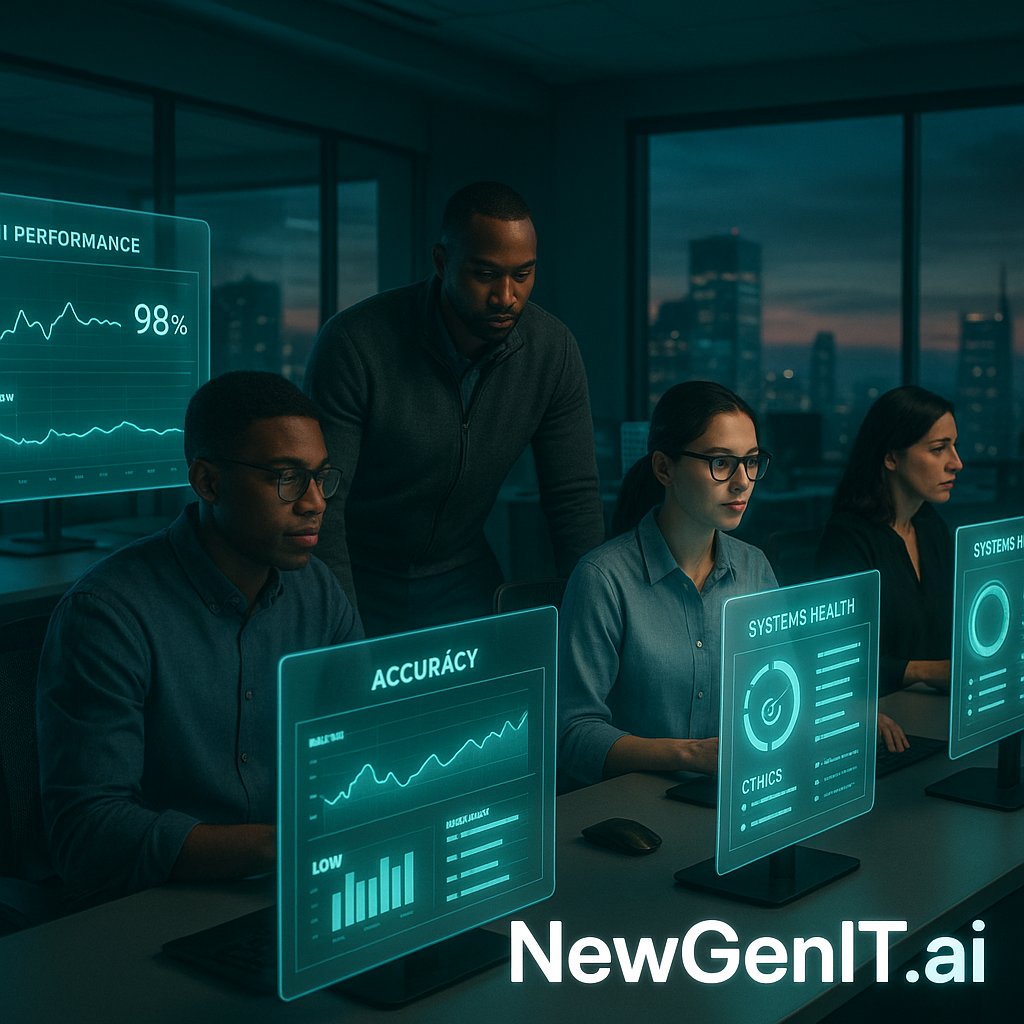
Monitoring an AI system is fundamentally different from monitoring a web server. Server uptime tells you the machine is running. It tells you nothing about whether the model is making good decisions. We watch several layers simultaneously.
Performance and accuracy metrics
We track how well the model is actually doing its job over time , precision, recall, accuracy, and the business-specific metrics that matter to you. If a fraud model's false-positive rate creeps up, that's blocked legitimate transactions and frustrated customers. We flag it before your call centre does.
Latency and system health
A model that takes eight seconds to respond might as well be broken for a real-time application. We monitor inference latency, throughput, GPU and memory utilisation, and the health of the surrounding infrastructure. In the South African context, this includes designing for resilience during load-shedding , failover to redundant compute, graceful degradation, and cached responses so your AI doesn't go dark every time Stage 6 hits.
Drift detection
This is the big one. We continuously compare the distribution of live production data against the data the model was trained on. When the inputs start looking materially different , a new product line, a demographic shift, a change in how users phrase their questions , we catch it early and trigger a review before accuracy collapses.
The goal isn't to react to problems. It's to see them coming three weeks out and quietly fix them before anyone in the business notices.
What We Maintain
Monitoring tells you something is wrong. Maintenance is what keeps it right. Our maintenance work falls into three broad buckets.
- Retraining and updating. When drift crosses a threshold, or when fresh, high-quality data becomes available, we retrain the model. This isn't a "rip and replace" , it's a controlled process with validation against a holdout set, staged rollouts, and the ability to roll back instantly if the new version underperforms.
- Security patching. AI systems introduce new attack surfaces: prompt injection, model inversion, data poisoning, and adversarial inputs. We keep the underlying frameworks, libraries, and dependencies patched, and we monitor for the emerging threat patterns specific to machine-learning systems.
- Pipeline hygiene. The data pipeline feeding your model is as important as the model itself. We maintain the ingestion, cleaning, and feature-engineering steps so that "garbage in" never quietly becomes "garbage out."
There's a cost dimension here too. AI compute, particularly on cloud GPUs billed in dollars, adds up fast against a rand budget. Part of ongoing maintenance is optimisation , right-sizing infrastructure, batching where possible, and caching aggressively so you're not paying premium rates for wasteful inference.
What We Report
None of this monitoring and maintenance matters if your IT team can't see it. Transparency is non-negotiable, and it's where a lot of "managed AI" offerings fall short , they operate as a black box, which is exactly what you don't want sitting on top of another black box.
Our reporting gives your team dashboards that answer the questions leadership actually asks:
- Is the AI working? Accuracy trends, business outcomes delivered, and how performance compares to the baseline at launch.
- Is it being used? Usage statistics, adoption across teams, and where the value is concentrating , so you can double down on what works.
- Is it compliant? This matters enormously under POPIA. We report on how personal information flows through the system, what's being processed, and whether the model's decisions meet the requirements around automated decision-making and data subject rights. If you operate across borders, we factor in frameworks like the EU AI Act too.
- Is it fair? Bias and fairness metrics, so you can demonstrate the model isn't systematically disadvantaging any group , a growing area of regulatory and reputational risk.
The point of all this reporting is proactive decision-making. When your compliance officer, your CIO, and your board can all see the same clear picture, risk stops being a surprise and becomes something you manage on your terms.
Why Outsource This Instead of Building It Internally
Some organisations will ask the fair question: why not just build an internal ML-ops capability? Sometimes that's the right answer, especially at large scale. But for most South African enterprises, the maths doesn't favour it.
The skills required , ML engineering, data engineering, security, and compliance expertise , are scarce and expensive locally. Assembling a full team to babysit one or two production models is hard to justify. More importantly, it pulls your best technical people into maintenance work when you'd rather have them building the next thing that moves the business forward.
Managed AI Operations lets your IT team keep full visibility and control while offloading the relentless, specialised operational grind. You set the direction; we keep the machinery running reliably underneath it.
Takeaways
If you're running AI in production, or about to, keep these principles close:
- Go-live is the beginning of the work, not the end. Budget for the operational phase, because it's where value is won or lost.
- Silent failure is the real risk. AI degrades quietly through drift. Active monitoring is the only defence.
- Compliance is continuous. Under POPIA, "we checked it at launch" won't hold up. You need ongoing evidence that your AI handles personal data lawfully and fairly.
- Transparency protects you. Insist on dashboards and reporting you can actually understand and act on.
- Focus your scarce talent on innovation. Let a managed operation handle the maintenance grind so your team builds what's next.
How is your organisation handling AI lifecycle management after deployment? Are you monitoring for drift, or are you flying blind once the model goes live? We'd love to hear where you're at , drop your experiences or questions below, and if you'd like a candid assessment of your current AI operations, reach out to the team at NewGenIT.ai.