Ask any South African who has filed an insurance claim after a burst geyser, a smash-and-grab, or hail damage to their car, and you'll hear a familiar story: the endless back-and-forth of emails, the request to "please resubmit" documents that were already sent, and the sinking feeling of waiting weeks for a decision. The claims process is where insurers either earn loyalty or lose it , and right now, too many are losing it.
This is precisely the gap that an AI-embedded Full Digital Experience (FDE) is built to close. Not as a shiny front-end chatbot bolted onto a legacy system, but as intelligence woven through the entire claims journey , from first notification of loss to final payout. Let's unpack what that actually looks like in practice, and why it matters for insurers operating in the South African market.
What "AI-Embedded FDE" Actually Means
The term "Full Digital Experience" gets thrown around loosely, so let's be precise. A genuine FDE means a customer can complete an entire process , in this case a claim , through digital channels without ever needing to fall back on a call centre or a branch visit. The "AI-embedded" part is what makes that end-to-end journey intelligent rather than just a digitised version of the old paperwork.
The difference is subtle but enormous. A digitised claims form is still a form. An intelligent claims experience reads the documents you upload, understands what's in them, checks them against policy terms, flags anomalies, and routes the claim to the right place , often before a human has even looked at it.
There are three areas where this embedding delivers the most value, and each deserves a proper look.
AI-Powered Triage: Getting Claims to the Right Place, Fast
Triage is where most claims processes quietly bleed time. A claim comes in, sits in a queue, gets manually reviewed, categorised, assigned a severity, and only then routed to an adjuster. Multiply that by thousands of claims a month and you have a bottleneck that no amount of extra staff comfortably solves.
AI-powered triage changes the maths. When a claim is submitted, the system can instantly:
- Classify the claim type , motor, household, liability, and so on , based on the description and attached evidence.
- Assess likely severity and urgency, pushing a total-loss vehicle claim ahead of a minor windscreen chip.
- Detect potential fraud indicators by cross-referencing patterns that a human reviewer might miss under time pressure.
- Route the claim to the correct team or, for straightforward low-value claims, into a straight-through processing path.
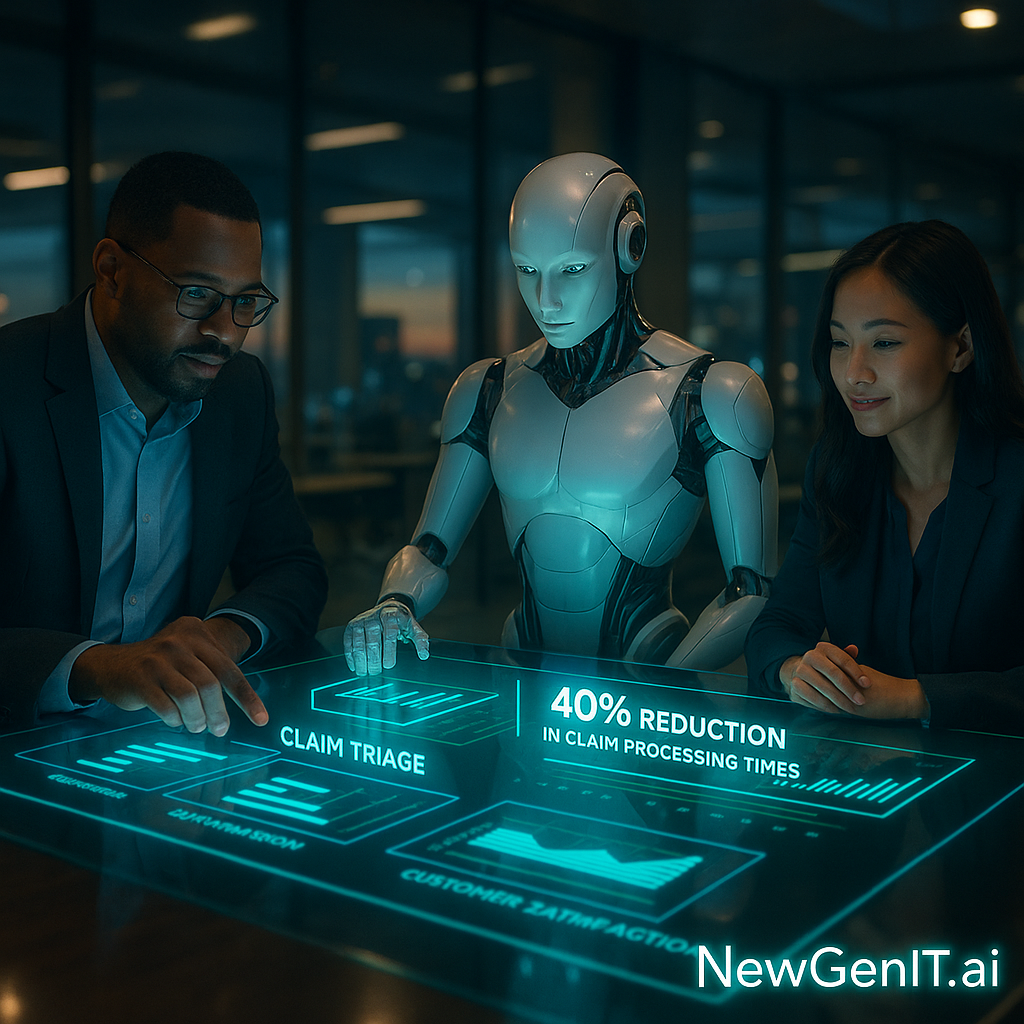
The result is faster response times and fewer manual errors. Industry analyses point to claim processing time reductions of up to 40% when AI triage is embedded properly , and in a market where customers increasingly compare their insurer to the responsiveness of their banking app, that speed is a genuine differentiator.
The claims that need a human get to a human faster. The claims that don't need one get resolved without waiting in a queue behind those that do.
Automating Documentation with NLP , Without Losing Compliance
Claims are drowning in documents: police reports, quotations, medical records, invoices, photographs, correspondence. Historically, a person read each one, extracted the relevant information, and typed it into a system. It's slow, tedious, and error-prone.
Natural language processing (NLP) flips this. Modern AI can read an unstructured document , a mechanic's quote or an assessor's report , and pull out the structured data an insurer needs: amounts, dates, part numbers, policy references. It can summarise a lengthy medical report into the points that matter for a claim decision. It can even check whether a submitted document actually matches what was requested.
For South African insurers, the compliance dimension is not optional. POPIA places real obligations on how personal information is collected, processed, and stored. An AI system handling claims documentation must be designed with data minimisation and purpose limitation in mind from day one , processing only what it needs, keeping audit trails, and ensuring that automated decisions remain explainable. Done well, AI actually strengthens compliance: every extraction and decision is logged, consistent, and reviewable, which is far more than can be said for a rushed human at the end of a long day.
This is where a Forward Deployed engineering approach earns its keep. You don't want a generic model guessing at South African document formats and regulatory requirements. You want the AI configured against your actual policy wordings, your real document types, and the local regulatory context.
Embedding AI in Client Operations for Proactive Service
The third area , and often the most overlooked , is what happens on the customer's side of the glass. Most claims communication is reactive: the customer chases, the insurer responds. AI embedded in client operations inverts that relationship.
Imagine a claimant who receives a proactive update the moment their claim moves to the next stage, in plain language, without having to phone in. Imagine the system detecting that a claim is missing a single document and requesting exactly that document , once, clearly , rather than sending a vague "your claim is on hold" message. Imagine personalised communication that reflects the customer's actual policy and history, not a generic template.
These aren't futuristic fantasies. They're achievable today, and they compound into meaningfully higher retention. When customers feel informed and in control during a stressful claim, they stay. When they feel ignored, they shop around at renewal , and in South Africa's competitive short-term insurance market, switching has never been easier.
The Local Reality: Load-Shedding, Connectivity, and Trust
Any honest conversation about digital transformation in South Africa has to reckon with local conditions. Load-shedding disrupts systems and customer access alike. Connectivity is uneven. And there remains a segment of the population that simply does not trust a fully automated process with something as consequential as a claim.
A well-designed AI-embedded FDE accounts for all of this. That means:
- Resilient architecture that degrades gracefully during power and connectivity interruptions, with queued processing that catches up automatically.
- Low-bandwidth-friendly interfaces, including WhatsApp-based claim submission, which for many South Africans is the most reliable digital channel they have.
- Human-in-the-loop escalation so that AI handles the volume and the routine, while people handle the complex and the emotional , the cases where empathy matters more than speed.
The goal is never to remove humans entirely. It's to free them from the drudgery so they can spend their time where it genuinely counts.
Key Takeaways for CX and Claims Leaders
If you're responsible for customer experience or claims operations, here's what to hold onto:
- Triage is your fastest win. AI-powered classification and routing delivers visible speed improvements , up to 40% faster processing , without requiring you to rebuild everything at once.
- NLP-driven documentation cuts errors and strengthens compliance simultaneously, provided it's built with POPIA baked in rather than bolted on.
- Proactive client operations drive retention, and retention is where the real economic value sits in a market where acquisition is expensive.
- Local context is not a footnote. Load-shedding resilience, WhatsApp channels, and human escalation paths are what separate a demo that impresses from a system that survives contact with South African reality.
Embedding AI into a Full Digital Experience isn't about chasing a trend , it's about meeting customers where they already are, at the moment they need you most. The insurers who get this right won't just process claims faster. They'll turn one of the most stressful moments in the customer relationship into the one that earns lasting loyalty.
How is your organisation approaching AI within its claims workflows , and where are you hitting the walls? That's exactly the kind of problem we like to roll up our sleeves and solve on the ground with our clients.