In today’s fast-evolving technology landscape, South African CIOs, IT directors, and business decision-makers face mounting pressure to rapidly adopt innovative solutions that deliver tangible results. The challenges are unique, from coping with load-shedding that disrupts operations to navigating complex data privacy regulations like the Protection of Personal Information Act (POPIA). With growing competition both locally and internationally, businesses in hubs such as Sandton, Durban, and Cape Town must leverage new technologies efficiently to stay competitive.
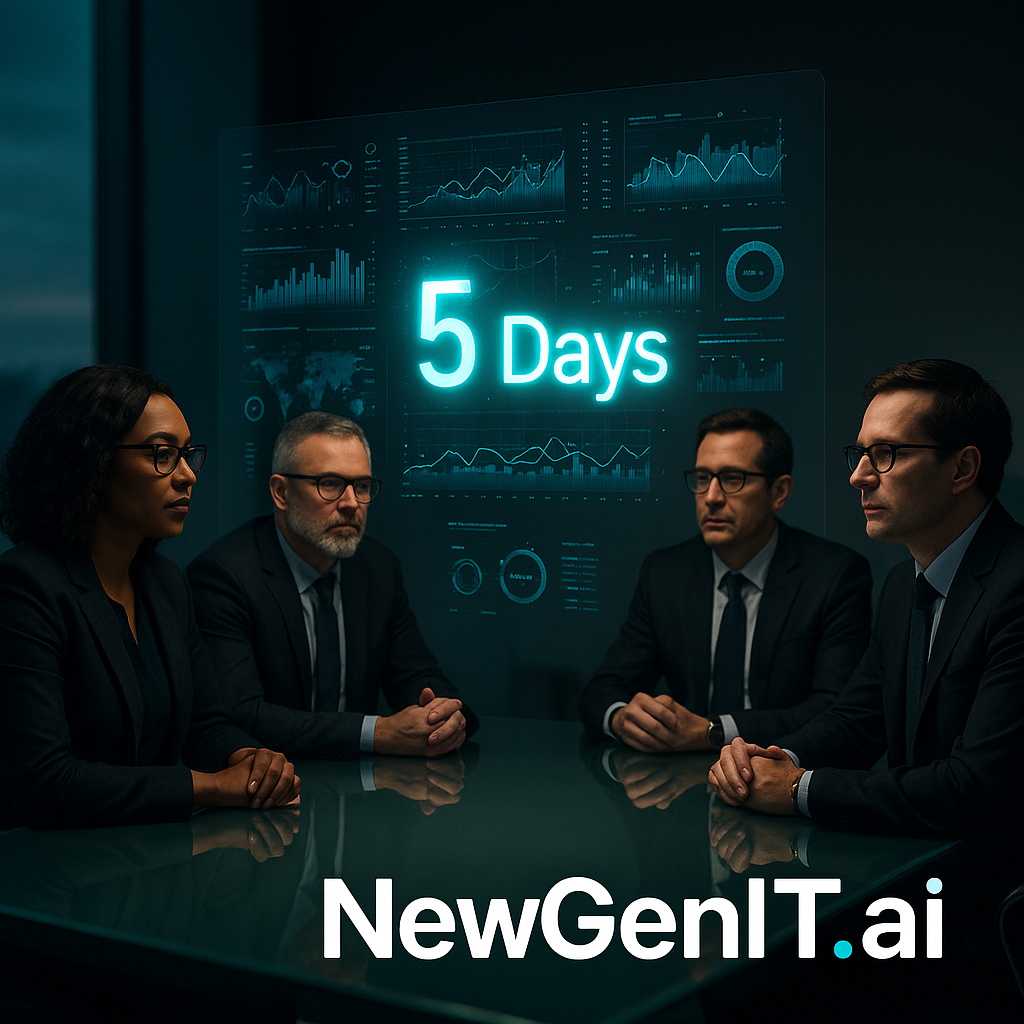
The NewGenIT AI Impact Sprint is an innovative program designed specifically to address these pressures by delivering a working AI system into production in just 5 business days. It utilizes your organisation’s real data to create bespoke AI tools aimed at solving your distinct business challenges while ensuring compliance and practical implementation.
Why Accelerate AI Delivery?
Traditional AI projects typically involve long, drawn-out development phases that can stretch over months or even years, often resulting in significant sunk costs before a usable solution emerges. This can deter IT leaders from investing further, especially in the face of uncertain returns and resource constraints.
The NewGenIT AI Impact Sprint flips this model by compressing delivery into a focused week-long engagement. This methodology allows South African companies struggling with issues like unpredictable power (load-shedding) to quickly capitalise on automation, predictive analytics, or optimisation tools that can improve operational continuity and efficiency.
Consider an e-commerce company in Cape Town experiencing erratic traffic patterns during load-shedding periods. A rapid AI solution that predicts peak demand or customer churn can be game-changing, implemented within days rather than months, allowing the business to respond dynamically to market conditions.
How the 5-Day Sprint Works: Steps and Stakeholder Integration
The AI Impact Sprint is structured around agile principles with constant collaboration from key stakeholders:
- Day 1 , Discovery & Data Assessment: Stakeholders from IT, business units, and data teams assess the available data quality, identify compliance requirements such as POPIA, and define measurable objectives aligned with business priorities.
- Day 2-3 , Rapid Prototyping: Using cloud or on-premise infrastructure adapted for South African businesses’ needs and constraints, AI engineers develop initial models using your organisation’s real data, refining them with direct input from business users.
- Day 4 , Validation & Feedback: The prototype is presented in an interactive session. IT teams evaluate integration feasibility, while compliance officers review data handling practices to ensure all POPIA provisions are met.
- Day 5 , Deployment & Next Steps: A working AI solution is deployed into production or staged environments, complete with documentation and a clear roadmap for scaling or refinement.
This hands-on approach reduces the usual risks associated with AI implementation by keeping decision-makers continually involved, paving the way for smoother adoption and faster realisation of value.
Addressing South African Market Realities
AI adoption often struggles against contextual challenges faced by South African companies. Beyond load-shedding and infrastructure reliability, budget constraints make it imperative to demonstrate quick returns on technology investments.
The NewGenIT AI Impact Sprint is priced competitively in South African rand (ZAR) terms, enabling mid-sized enterprises and even smaller businesses in dynamic sectors , from financial services in Sandton to manufacturing in Durban, to explore AI without committing to large upfront expenditures. By providing a clear proof of concept in days, organisations can better justify further AI investments to boards and shareholders.
Moreover, the sprint incorporates data governance and security measures tailored to comply with POPIA, which governs how personal information is processed, stored, and shared. This means AI solutions deployed through the sprint integrate privacy-by-design principles, helping companies avoid costly non-compliance penalties while maintaining customer trust.
Case Example: Retail Chain in Gauteng
Consider a large retail chain headquartered in Sandton facing challenges with inventory management impacted by inconsistent supply due to logistics interruptions and load-shedding. The company participated in the AI Impact Sprint to rapidly prototype an AI-driven demand forecasting model.
By leveraging historical sales data alongside external datasets such as weather patterns and holiday calendars, within 5 days the solution provided actionable insights to optimise stock levels across 50+ stores. The outcome was a 15% reduction in stockouts within the first month of implementation, translating to an estimated R2 million increase in monthly revenue.
The transparent collaboration throughout the sprint ensured that IT leadership was fully engaged, facilitating rapid deployment despite legacy system complexities.
Empowering IT Leaders and Business Decision-Makers
South African IT leaders who engage with the AI Impact Sprint experience multiple benefits:
- Risk Mitigation: The sprint model avoids excessive upfront spending and lengthy delivery times, decreasing the risk of stalled projects.
- Actionable Outcomes: Solutions are tangible and measurable, with clear KPIs defined from the start.
- Enhanced Collaboration: Cross-functional teams work together, promoting buy-in and knowledge transfer.
- Compliance & Security: Built-in adherence to POPIA and other local regulations minimises legal exposure.
- Scalable Roadmap: Post-sprint, organisations have a clear plan for AI evolution aligned with business growth.
These factors make the AI Impact Sprint an attractive pathway for organisations seeking quick wins in their digital transformation journeys, especially amid South Africa’s competitive and resource-constrained environments.
Preparing Your Organisation for the AI Impact Sprint
To maximise the benefits of the sprint, IT and business teams should prepare by:
- Identifying a high-impact AI use case aligned with business objectives that can leverage available data.
- Ensuring data accessibility, with appropriate governance and privacy controls to comply with POPIA.
- Committing key stakeholders including IT, business leaders, and compliance teams to participate actively during the sprint week.
- Allocating necessary infrastructure resources, whether cloud or on-premise, considering local connectivity and power considerations.
By focusing effort upfront on preparation, organisations increase the likelihood of delivering AI solutions within the intense 5-day timeframe that meet business needs and compliance requirements.
Conclusion
The NewGenIT AI Impact Sprint offers a game-changing approach for South African enterprises to overcome traditional AI adoption barriers. By harnessing real data and agile collaboration, it delivers a functional AI solution into production in just one business week, helping companies accelerate innovation, respond to real local challenges like load-shedding, and adhere to POPIA.
In a rapidly transforming digital economy, waiting months or years for AI results is no longer viable. The AI Impact Sprint empowers your organisation to experience meaningful AI impact quickly and with transparency.
Discussion
What are the biggest hurdles your organisation faces when trying to implement AI solutions, and how could a rapid 5-day model like the NewGenIT AI Impact Sprint change your approach to digital transformation? We invite your thoughts and experiences in the comments below.