Implementing artificial intelligence (AI) in IT operations promises significant transformation, but quantifying the return on investment (ROI) remains a persistent challenge for many South African enterprises. At NewGenIT, we understand that reliable AI ROI measurement isn’t just a “nice-to-have” , it is essential for sustained success amid the unique operational and market realities here in South Africa.
This article delves into the four key categories we rigorously track from day one of AI deployment, ensuring that IT teams and business leaders across Johannesburg, Cape Town, Durban, and beyond can justify investments with solid data, make timely strategic adjustments, and firmly anchor AI projects within broader business goals.
1. Operational Efficiency Gains: Mitigating Local IT Challenges
For South African IT operations leaders, operational efficiency means more than streamlining workflows; it is about resilience in the face of endemic challenges such as load-shedding, bandwidth variability, and resource constraints. AI-powered automation can significantly help IT teams respond faster to incidents and maintain system uptime despite these obstacles.
At NewGenIT, we monitor improvements in:
- Automation Rate: Percentage of repetitive tasks eliminated by AI tools (e.g., system patching, alerts triage). In one Johannesburg banking client, automation grew from 15% to 60% within six months, freeing up 15 FTEs to focus on strategic projects.
- Incident Response Time: Reduction in Mean Time to Repair (MTTR) post-AI deployment. Cape Town-based logistics firms have reported a 30-40% decrease in MTTR, translating into fewer operational disruptions.
- System Uptime: Enhanced monitoring and predictive maintenance prevent downtime, critical in environments affected by planned and unplanned power outages.
Such operational gains are directly measurable and constitute a firm pillar in your AI ROI calculation.
2. Cost Optimization: Reducing IT Spend in a Volatile Economy
South Africa’s volatile rand exchange rates and rising inflation pressures mean every rand saved matters. AI can optimize both direct and indirect IT costs across hardware, cloud resources, and labor.
Key cost metrics to monitor include:
- Cloud Resource Utilization: AI-driven analytics can lower cloud costs by identifying underused compute and storage resources. For example, a Durban-based SaaS provider trimmed cloud costs by approximately 18% within the first year of AI implementation.
- Labor Efficiency: With AI handling tier-1 support queries and routine audits, labor hours can be reallocated or reduced, yielding cost savings without quality loss.
- CapEx and OpEx Reduction: AI enables smarter capacity planning and preventive maintenance, averting costly hardware failures and unnecessary upgrades.
Tracking these cost optimization indicators in South African rands allows leaders to link AI investment directly to financial outcomes, critical for CIOs and CFOs navigating tight budgets.
3. Service Quality Enhancements: Elevating User Experience Amid Constraints
South African organizations often deal with diverse user bases spanning urban centers like Sandton to more rural provinces, with varying levels of connectivity and infrastructure reliability. AI can play a pivotal role in quality of service improvements, reducing downtime, expediting issue resolution, and enhancing the end-user experience.
Measurable service quality gains include:
- Downtime Reduction: By proactively identifying risks and automating alerts, AI helps slash unscheduled outages. One Cape Town financial services client decreased downtime by 22% within nine months.
- Faster Resolution Times: AI-powered chatbots and diagnostic tools accelerate problem identification and solution delivery.
- User Satisfaction Scores: Post-implementation surveys and Net Promoter Scores (NPS) provide direct feedback loops demonstrating improved IT service delivery.
Tracking these user-centric metrics aligns AI ROI with business impact, reinforcing compliance with South Africa’s Protection of Personal Information Act (POPIA) through faster incident management and data breach response times.
4. Innovation Impact: Driving New Business Value Beyond Traditional Metrics
True AI ROI extends beyond operational improvements to measurable innovation impact, how AI enables new services, capabilities, or business models. For South African businesses evolving in competitive sectors such as finance, mining, and retail, AI often unlocks previously impossible opportunities.
Examples and metrics include:
- New AI-Enabled Products: AI-powered predictive analytics or customer insights generating additional revenue streams. For instance, a Johannesburg retail company introduced AI-driven personalized marketing campaigns that improved sales conversion rates by 12%.
- Time-to-Market Improvements: Faster development cycles via AI-assisted software testing and code review reduce delays.
- Competitive Differentiation: AI capabilities adopted as barriers to entry, attracting new clients and partnerships.
These innovation-related metrics often require collaboration between IT and business leadership to quantify but are crucial in South Africa’s dynamic market environment.
Bringing It All Together: A Framework Tailored to South African Realities
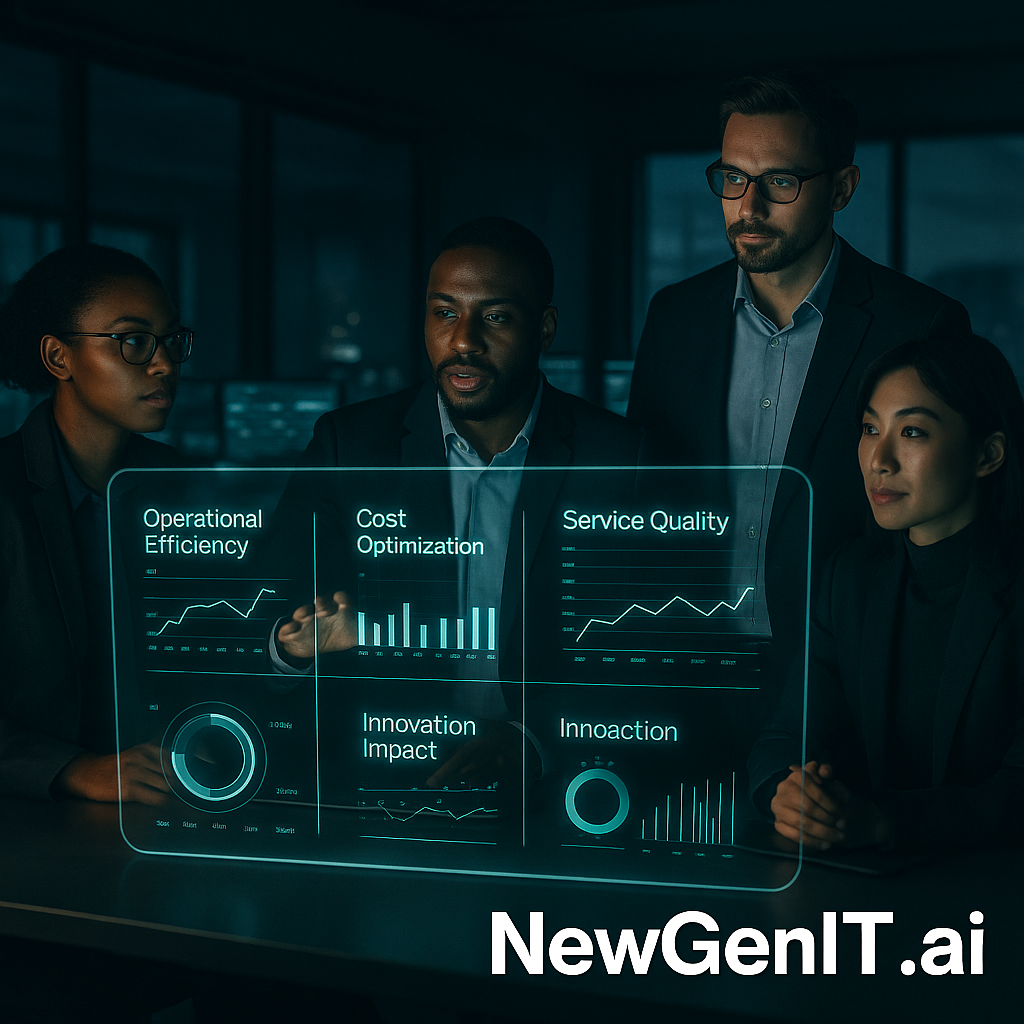
NewGenIT’s framework integrates these four categories, Operational Efficiency, Cost Optimization, Service Quality, and Innovation Impact, into a comprehensive AI ROI dashboard that executives can track from project inception. This approach enables:
- Early Course Corrections: Real-time data on AI effectiveness uncovers issues before costs escalate.
- Clear Business Alignment: Metrics speak the language of both IT teams and business decision-makers, enhancing stakeholder buy-in.
- Context-Aware Assessment: Data is calibrated against local cost structures, infrastructure realities, and regulatory requirements like POPIA.
South Africa’s IT landscape uniquely benefits from this multidimensional approach, ensuring AI investments contribute to tangible business outcomes rather than abstract technical achievements.
Practical Takeaways for IT Leaders and Decision-Makers in South Africa
- Start measuring AI performance and ROI metrics from day one, don’t wait for project completion.
- Engage cross-functional teams to define what success looks like across all four categories relative to your specific business context.
- Leverage local partners, such as NewGenIT, who understand South African market nuances like load-shedding impacts and compliance frameworks.
- Invest in tools that provide comprehensive dashboards integrating cost, efficiency, quality, and innovation data to enable holistic decision-making.
- Regularly review and adapt your AI measurement criteria to reflect evolving business needs and external conditions such as economic cycles or regulatory changes.
Conclusion: Measuring AI ROI is Non-Negotiable for South African IT Success
AI has undeniable potential to revolutionize IT operations and business outcomes in South Africa. However, without rigorous, data-driven measurement frameworks focusing on operational efficiency, cost optimization, service quality, and innovation, organizations risk misaligning expectations and investments.
NewGenIT’s proven approach empowers South African IT leaders and business decision-makers to transform AI projects into predictable, measurable value generators, even amid the complexities of local market conditions.
What metrics does your organisation prioritise when assessing AI ROI? How are you addressing the specific challenges of South African IT environments? We invite you to join the conversation and share your insights.