
In South Africa’s dynamic IT landscape, dominated by challenges such as load-shedding, strict governance frameworks like POPIA, and evolving market demands, the adoption of Artificial Intelligence (AI) has become a critical lever for business competitiveness and operational excellence. However, measuring the return on investment (ROI) of AI initiatives remains a complex challenge for IT leaders and decision-makers. Traditional financial metrics alone often fall short of capturing the multifaceted value AI delivers.
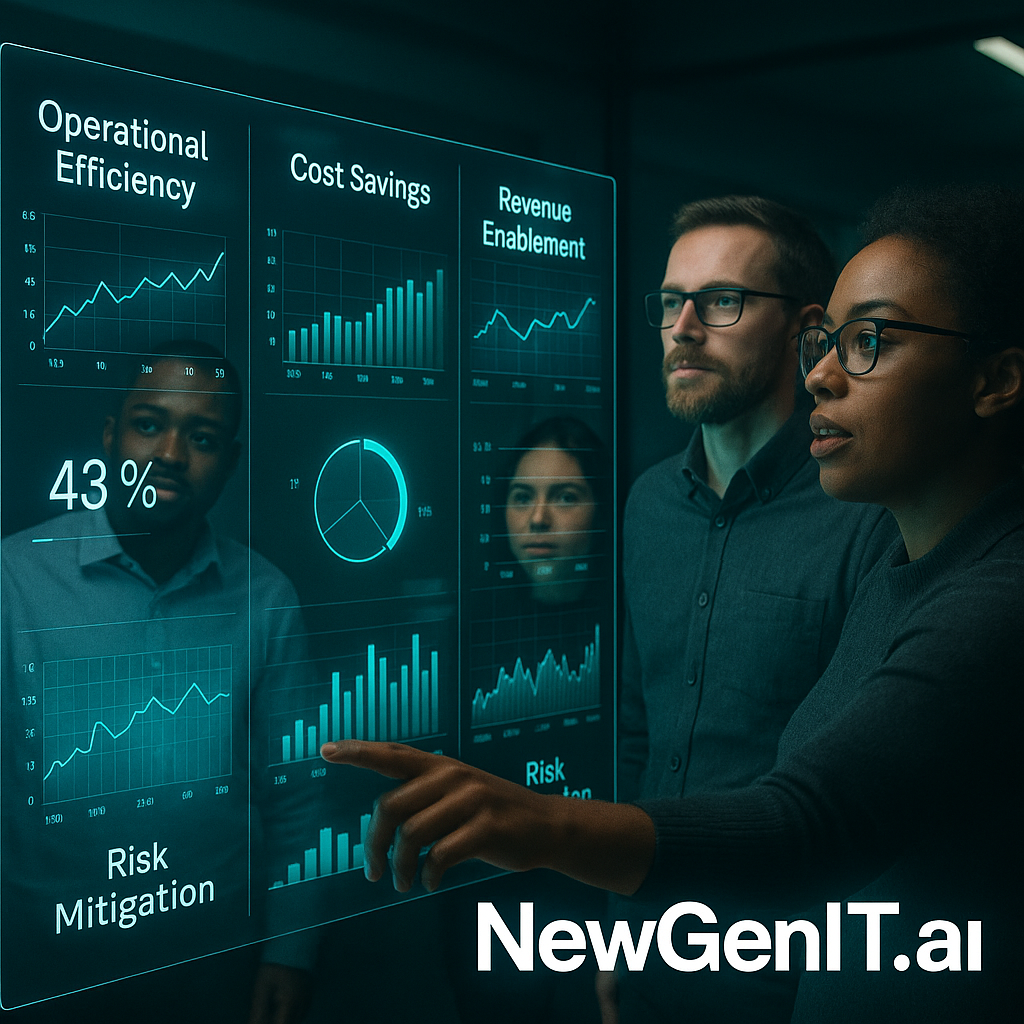
At NewGenIT, a forward deployed AI engineering firm rooted in the South African business context, we advocate for a multidimensional approach to AI ROI measurement. From day one of any AI deployment, we track four essential categories that provide a holistic and actionable view of AI’s impact on your organisation:
1. Operational Efficiency: Driving Productivity Amid Load-Shedding and Resource Constraints
Operational efficiency measures how AI streamlines workflows, automates manual tasks, and enhances uptime , crucial in South Africa’s environment where load-shedding frequently disrupts IT operations and productivity. For example, an enterprise in Sandton leveraging AI-driven predictive maintenance reduced unplanned downtime of critical infrastructure by 30%, saving an estimated R1.5 million annually in operational disruptions.
By quantifying time saved and process acceleration, AI enables IT Ops teams to recover productivity lost during power interruptions. Automation reduces reliance on human intervention, allowing staff to focus on higher-value tasks and strategic initiatives. Key efficiency metrics to monitor include mean time to resolution (MTTR), system uptime percentages, and percentage reduction in manual workflows.
2. Cost Savings: Reducing Infrastructure and Support Expenses in a Rand-Sensitive Economy
South African companies face tight budgets and exchange rate volatility impacting technology spending. AI offers significant cost-saving potential by optimizing infrastructure utilization, predicting failures before costly downtime, and automating support functions.
For instance, a Cape Town-based ISP implemented AI to optimize their network resources, resulting in a 25% reduction in bandwidth costs and support tickets reduced by 40%, translating into direct operational savings of approximately R3 million per year. Additionally, AI-powered automation lowers the costs of 24/7 monitoring and incident management, critical for businesses operating across multiple regions like Durban and Johannesburg.
Tracking these savings involves comparing baseline IT spend on infrastructure, licensing, and human resources before and after AI deployment, accounting for ongoing maintenance and upgrade expenses.
3. Revenue Enablement: Leveraging AI to Enhance Customer Experience and Market Position
AI’s influence extends beyond cost reduction to enabling new revenue streams and enhancing customer engagement. In a competitive South African market, characterised by growing digital adoption but also economic pressures, AI-driven product enhancements and personalised services can differentiate brands and increase market share.
Consider a retail chain in Gauteng using AI-based recommendation engines and CRM automation. This enabled a 15% uplift in average basket size and improved customer retention, contributing to annual revenue growth of R10 million. AI can also accelerate time-to-market for new digital products and services, a decisive factor in fast-paced hubs like Sandton or Stellenbosch.
Metrics here include incremental revenue attributable to AI-augmented offerings, customer lifetime value improvements, and conversion rate uplifts.
4. Risk Mitigation: Enhancing Security and Compliance in the POPIA Era
With South Africa’s Protection of Personal Information Act (POPIA) imposing strict compliance requirements, AI plays a vital role in mitigating risks related to data breaches, cyber threats, and regulatory penalties. AI-powered threat detection systems can identify anomalies and potential attacks faster than traditional mechanisms, reducing incident response times and minimizing exposure.
For example, a financial services firm operating in Johannesburg deployed AI-based security analytics that decreased security breach incidents by 50%, avoiding potential penalties estimated in the millions of rand. AI also supports compliance monitoring by auditing large data sets automatically, ensuring adherence to POPIA standards and enhancing audit readiness.
Risk mitigation ROI measurement focuses on incident reduction, cost avoidance related to breaches, fines, and remediation efforts, alongside improvements in compliance audit scores.
Holistic AI ROI Measurement: Combining Dimensions for Informed Decision-Making
Measuring AI ROI through these four categories, operational efficiency, cost savings, revenue enablement, and risk mitigation, provides IT teams and business leaders with a nuanced understanding of AI’s impact. This multidimensional approach helps uncover hidden benefits and early warning signs that purely financial KPIs might miss.
In practice, organisations can establish baseline data before AI implementation, then continuously track metrics such as system uptime, support costs, revenue growth, and security incidents. Reporting dashboards that aggregate these insights facilitate transparent, data-driven discussions with stakeholders and enable iterative optimisation of AI initiatives.
Practical Takeaways for South African IT Leaders
- Start measurement at day one: Capture baseline metrics reflecting current operational, financial, revenue, and risk profiles before AI rollout.
- Contextualise metrics: Factor in South Africa-specific challenges like load-shedding impact on operational efficiency and regulatory implementations under POPIA.
- Use mixed qualitative and quantitative data: Combine hard cost savings with softer benefits like improved customer satisfaction or staff morale.
- Leverage local examples: Benchmark against companies in similar industries or regions such as Cape Town or Durban to set realistic targets.
- Communicate continuously: Share progress regularly through dashboards to maintain stakeholder buy-in and ensure alignment.
Conclusion: Positioning AI as a Strategic Enabler, Not just a Cost Centre
For South African organisations aiming to harness AI’s full potential, adopting a broad, multidimensional ROI measurement framework is critical. By tracking operational efficiency, cost savings, revenue enablement, and risk mitigation from day one, companies can clearly demonstrate AI’s value beyond upfront costs and justify ongoing investments.
This approach supports scalable AI adoption tailored to local market realities, empowering IT leaders and business decision-makers across Johannesburg, Sandton, Durban, and Cape Town to make data-driven, strategic choices.
Discussion: How is your organisation currently measuring AI ROI? What challenges do you face in capturing the full spectrum of AI’s impact, and which category do you find hardest to quantify clearly? Share your insights and approaches.