In the evolving digital landscape of South Africa, artificial intelligence (AI) is no longer a luxury but a necessity for IT operations teams aiming to maintain competitive edge. Yet, one of the biggest challenges facing IT leaders and business decision-makers is accurately measuring the return on investment (ROI) from AI projects. This is especially pertinent in South Africa’s unique operational environment, where factors like load-shedding disrupt workflows and POPIA regulations govern data management.
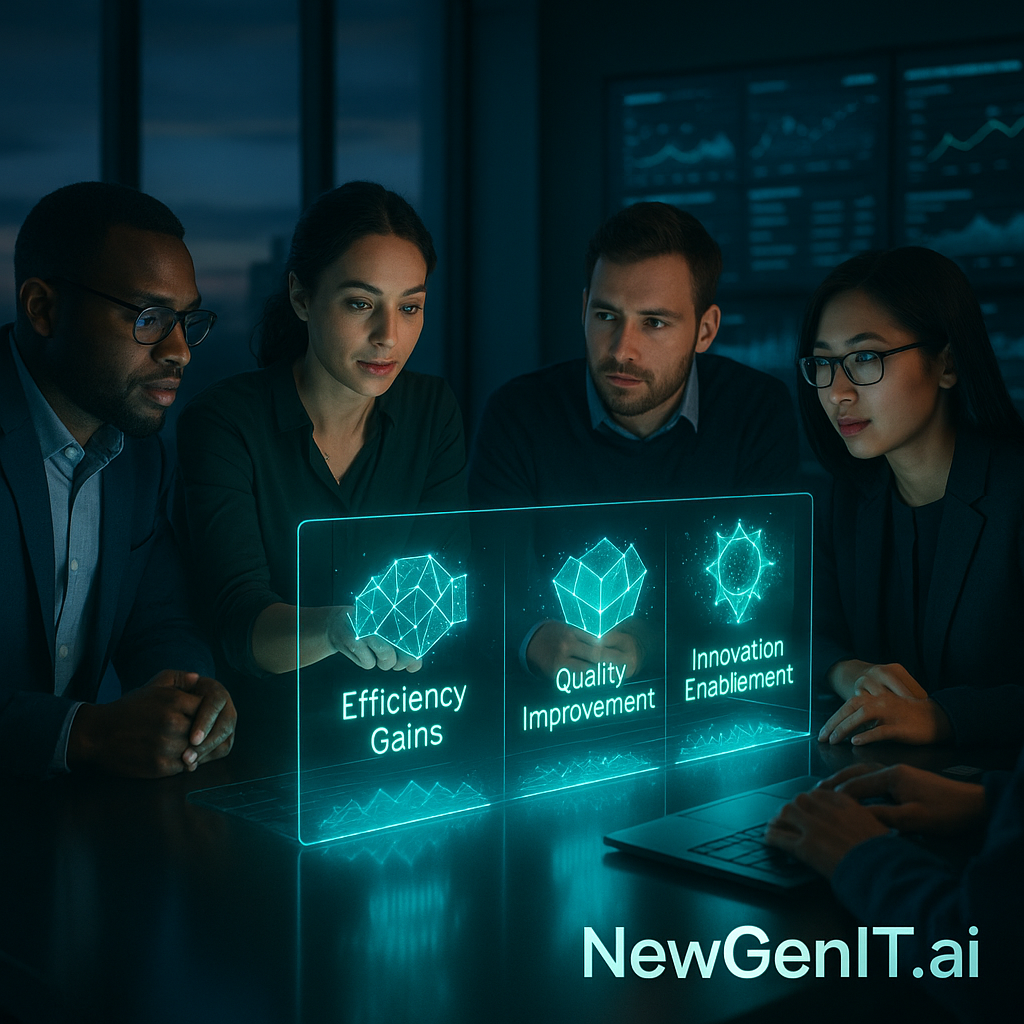
At NewGenIT.ai, we understand that measuring AI value goes beyond simple cost savings or revenue increases. From day one, we guide organisations to evaluate AI impact across four fundamental categories: Efficiency Gains, Quality Improvement, Risk Mitigation, and Innovation Enablement. This comprehensive framework empowers IT operations teams to both justify AI investments and to align implementation with broader strategic objectives.
Efficiency Gains: Optimising Time and Costs in a South African Context
Efficiency remains one of the most tangible AI ROI metrics, but in South Africa, the calculation is nuanced due to operational challenges like power outages. Load-shedding events can cause delays or downtime that nullify efficiency gains if not properly managed.
For example, AI-enabled automation in IT support can reduce manual ticket handling time by up to 40%, translating into savings of thousands of rands monthly in staff costs for a mid-sized enterprise in Sandton or Cape Town. By integrating AI with reliable backup power solutions and cloud infrastructures, businesses can maintain automation continuity even during outages, further safeguarding efficiency.
Furthermore, AI can dynamically allocate workloads and predict peak system demands , essential for South African companies balancing limited infrastructure and fluctuating availability. Tracking time saved, resource optimisation, and reduced manual effort quantitatively demonstrates AI’s contribution to operational continuity and cost reduction.
Quality Improvement: Enhancing Accuracy and Outcomes in Critical Processes
South Africa’s IT operations also demand a high bar for quality, especially where data protection under the Protection of Personal Information Act (POPIA) is concerned. AI can significantly improve quality by reducing errors in data handling, decision-making, and predictive maintenance.
Consider a Durban-based financial services firm leveraging AI-powered anomaly detection to monitor transaction irregularities and flag potential fraud in real-time. Over six months, the system reduced false positives by 30%, improving customer experience and regulatory compliance simultaneously. This contributes to cost avoidance by mitigating potential POPIA fines and reputational damage, which can run into millions of rand.
Quality improvement metrics should include error rate reductions, confidence levels of AI decisions, and increased predictive accuracy. Tracking these informs whether AI systems are enhancing operational reliability and customer trust relative to manual processes.
Risk Mitigation: Safeguarding Uptime and Compliance
Risk mitigation is particularly critical for South African enterprises dealing with limited infrastructure, cyber threats, and stringent compliance mandates. AI’s role here extends from lowering system downtime to bolstering security posture and ensuring adherence to regulatory frameworks.
For instance, a Cape Town-based manufacturing company implemented an AI-driven predictive maintenance system to monitor equipment health and schedule timely repairs. This reduced unplanned downtime by 25%, translating into an estimated R500,000 in monthly production savings.
Simultaneously, AI tools support compliance monitoring for IT teams by automating audit trails and data governance checks aligned with POPIA. Reduced risk of non-compliance fines, up to 10 million rand for serious breaches, provides direct financial benefits alongside operational stability. Measuring these aspects requires baseline risk assessments and continuous monitoring of downtime incidents, security breaches, and audit outcomes.
Innovation Enablement: Unlocking New Capabilities and Market Agility
Innovation is often the hardest ROI metric to define, but perhaps the most vital for South African businesses striving to leapfrog competitors amid a dynamic digital economy and infrastructure challenges.
AI enables new capabilities such as personalised customer interactions, faster product development cycles, and enhanced data insights that support better strategic decisions. A Sandton retail chain, for example, adopted AI-powered demand forecasting, enabling them to reduce inventory holding costs by 15% and decrease stockouts by 20%, driving improved customer satisfaction and revenue.
By measuring innovation ROI, we look at faster time-to-market for new solutions, increased customer engagement scores, and revenue growth attributed to AI-driven services. It’s important for IT leaders to link these metrics with business outcomes clearly, justifying continued innovation budgets.
Applying a Holistic Framework in South African IT Operations
Many South African organisations mistake early AI projects as cost-cutting exercises, overlooking the broader strategic value AI creates across efficiency, quality, risk, and innovation. NewGenIT.ai advocates for capturing all four ROI dimensions from project inception, supported by measurable KPIs tailored to local realities.
Practical steps include:
- Setting baseline benchmarks for time, error rates, downtime, compliance, and market responsiveness
- Utilising local data sources and infrastructure nuances in AI model training to enhance relevance and performance
- Employing continuous ROI monitoring dashboards accessible to IT and business leadership for transparent decision-making
- Aligning AI initiatives tightly with regulatory compliance such as POPIA and national operational challenges like load-shedding
This approach ensures South African IT leaders can demonstrate tangible AI value, secure stakeholder buy-in, and drive sustainable AI adoption.
Realistic Numbers: Making the Case for AI Investment in Rand
To contextualise the financial impact, consider a medium enterprise investing R2 million over one year in AI-powered IT automation. Efficiency gains might save 1,500 man-hours annually, at an average fully loaded cost of R300/hour, amounting to R450,000 in direct labour savings.
Quality improvements reducing error-related costs by 20% could translate into R250,000 savings, while risk mitigation avoiding just one major downtime incident might preserve revenues or avoid losses upwards of R1 million per event. Meanwhile, innovation-driven revenue upside from new AI-enabled services could contribute an additional R500,000 annually. Combined, these returns exceed the initial investment within 12 to 18 months, with ongoing benefits thereafter.
Conclusion: A Call to South African IT Leaders
Measuring AI ROI comprehensively is imperative for South African organisations navigating operational disruptions, regulatory complexity, and competitive pressures. By tracking efficiency gains, quality improvements, risk mitigation, and innovation enablement, IT operations teams can build robust cases for AI deployments that deliver real business value.
At NewGenIT.ai, we are committed to helping organisations apply this four-category framework from day one , ensuring AI initiatives are data-driven, transparent, and aligned with local market realities.
How is your organisation currently measuring AI ROI? What challenges have you faced in capturing the full scope of AI’s impact on IT operations? We invite you to share your experiences and insights in the comments below.