In South Africa's rapidly evolving IT landscape, where companies juggle digital transformation with unique local challenges like load-shedding and compliance under POPIA, understanding the real return on investment (ROI) from artificial intelligence (AI) initiatives is paramount. For IT leaders, engineers, and business decision-makers across major hubs such as Sandton, Durban, and Cape Town, the question is no longer if AI delivers value but how to measure that value accurately and comprehensively.
At NewGenIT.ai, a South African forward deployed AI engineering firm, we recognize that traditional ROI metrics tend to overlook critical facets of AI's impact, leading to undervaluation and missed opportunities. Our approach starts on day one, measuring AI ROI through four definitive categories that capture both tangible and intangible benefits. This holistic method empowers organisations to justify AI investments decisively, optimize ongoing projects, and scale transformative solutions within the South African market context.
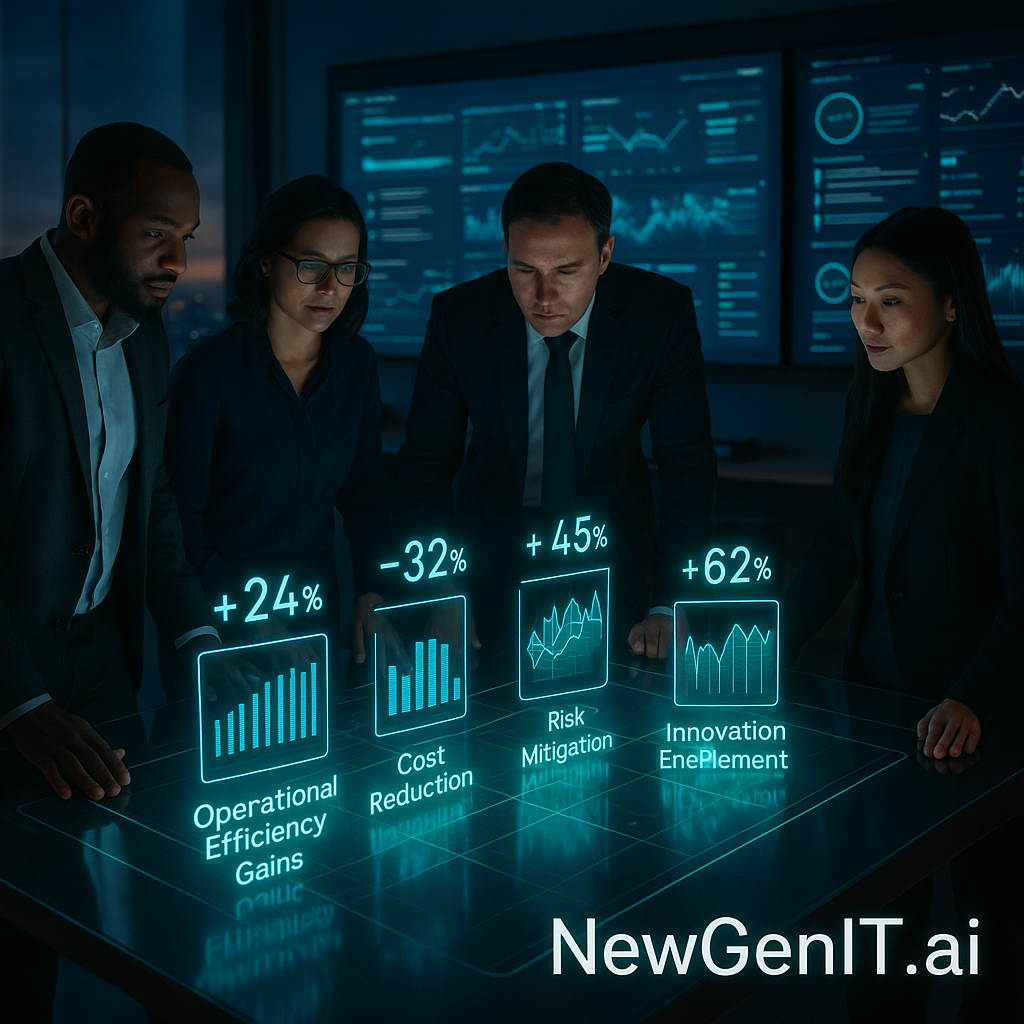
1. Operational Efficiency Gains: Time and Resource Savings
Operational efficiency remains the most immediate and measurable impact of AI in IT operations. In a local context where organisations often face constraints due to load-shedding and stretched manpower, AI-driven automation and predictive analytics can be game changers.
For example, an IT department in a Johannesburg-based financial institution reported a reduction of over 24% in time spent on manual incident triage within six months of implementing AI-enabled monitoring. This result translated to reassigning 15 full-time equivalent staffers towards higher-value tasks, effectively addressing South Africa's critical skills shortages.
Moreover, AI algorithms can predict potential load-shedding impacts on critical IT infrastructure downtime, enabling preemptive measures that protect service availability. Johannesburg and Cape Town data centres using NewGenIT.ai’s predictive models experienced a 15% decrease in unplanned outages during peak Eskom load-shedding periods.
2. Cost Reduction: Beyond the Obvious Savings
While cost saving is often cited as a top benefit, many organisations narrowly focus on immediate expenditure cuts, ignoring downstream financial advantages.
Through AI-powered root cause analysis, one Durban-based retail client reduced incident resolution costs by nearly 32%. Eliminating repeat fixes, lowering emergency third-party contractor involvement, and reducing downtime penalties collectively led to savings surpassing ZAR 3 million annually.
Other cost reductions include optimising cloud infrastructure spend, where AI dynamically scales resources to match demand, avoiding overprovisioning. South African enterprises with hybrid cloud environments reported lowering monthly cloud bills by up to 20%, helping mitigate budget pressures due to rand volatility.
3. Risk Mitigation: Reducing Downtime, Security Breaches, and Compliance Pitfalls
South Africa's regulatory landscape, dominated by the Protection of Personal Information Act (POPIA), mandates rigorous data security and system uptime standards. AI's role in risk mitigation is crucial to meet these stringent requirements.
AI-driven anomaly detection identifies suspicious network activity faster than manual methods, decreasing the likelihood of costly security breaches. For instance, a Cape Town-based financial services firm saw a 45% improvement in early threat detection rates after deploying AI-powered security analytics, thereby averting potentially multi-million rand penalties.
Additionally, AI assists in ensuring compliance by automating audit logging and flagging potential policy violations proactively, reducing risks related to POPIA non-compliance and avoiding fines.
Downtime reduction directly impacts revenue and reputation. In sectors like e-commerce or banking in Durban, each hour of unplanned downtime can incur losses exceeding ZAR 500,000. AI’s predictive maintenance capabilities enabled one client to cut system downtime by 40%, safeguarding revenue and customer trust.
4. Innovation Enablement: Elevating Service and Strategic Growth
Beyond operational metrics, AI fosters strategic innovation in South African businesses. By freeing IT teams from repetitive tasks, AI enables focus on transformative projects, spurring service improvements and new offerings.
For example, after adopting AI-driven customer sentiment analysis, a Sandton-based telecommunications operator enhanced its customer service experience, leading to a 25% reduction in churn and improving overall customer satisfaction scores.
Furthermore, AI supports predictive market analysis and informed decision-making, critical for enterprises navigating competitive pressures and rapid technology shifts. Such innovation underpins long-term growth, especially vital in South Africa’s challenging economic environment.
Practical Takeaways for South African IT Leaders
- Start with clear KPI definitions: Align AI ROI measurement categories with business objectives, considering local operational realities such as load-shedding and regulatory compliance.
- Capture quantitative and qualitative benefits: Combine data on time, cost, and risk with innovation outcomes like enhanced customer experience.
- Use AI monitoring tools tuned to the South African context: Address infrastructure volatility, hybrid cloud deployments, and emerging security threats unique to the region.
- Engage cross-functional teams: Include stakeholders from compliance, finance, and customer service to ensure a 360-degree view of AI impact.
- Leverage insights for continuous improvement: Regularly review ROI data to identify scaling opportunities and fine-tune AI deployments.
Conclusion: From Metrics to Meaningful AI Impact
Measuring AI ROI demands more than tracking cost savings or efficiency gains in isolation. In South Africa’s complex IT environment, a holistic approach that tracks operational efficiency, cost reduction, risk mitigation, and innovation enablement unlocks comprehensive visibility into AI’s true contribution.
NewGenIT.ai has seen how this framework helps South African organisations overcome typical challenges, ranging from budget constraints and compliance to infrastructure instability, to fully harness AI-driven value. By embedding this practice from day one, IT teams can confidently justify AI investments, accelerate digital transformation journeys, and build future-ready enterprises.
How is your organisation measuring the ROI of your AI initiatives? Are there additional metrics you consider essential in the South African context? Share your perspectives and experiences to foster a deeper conversation on capturing AI’s full value.