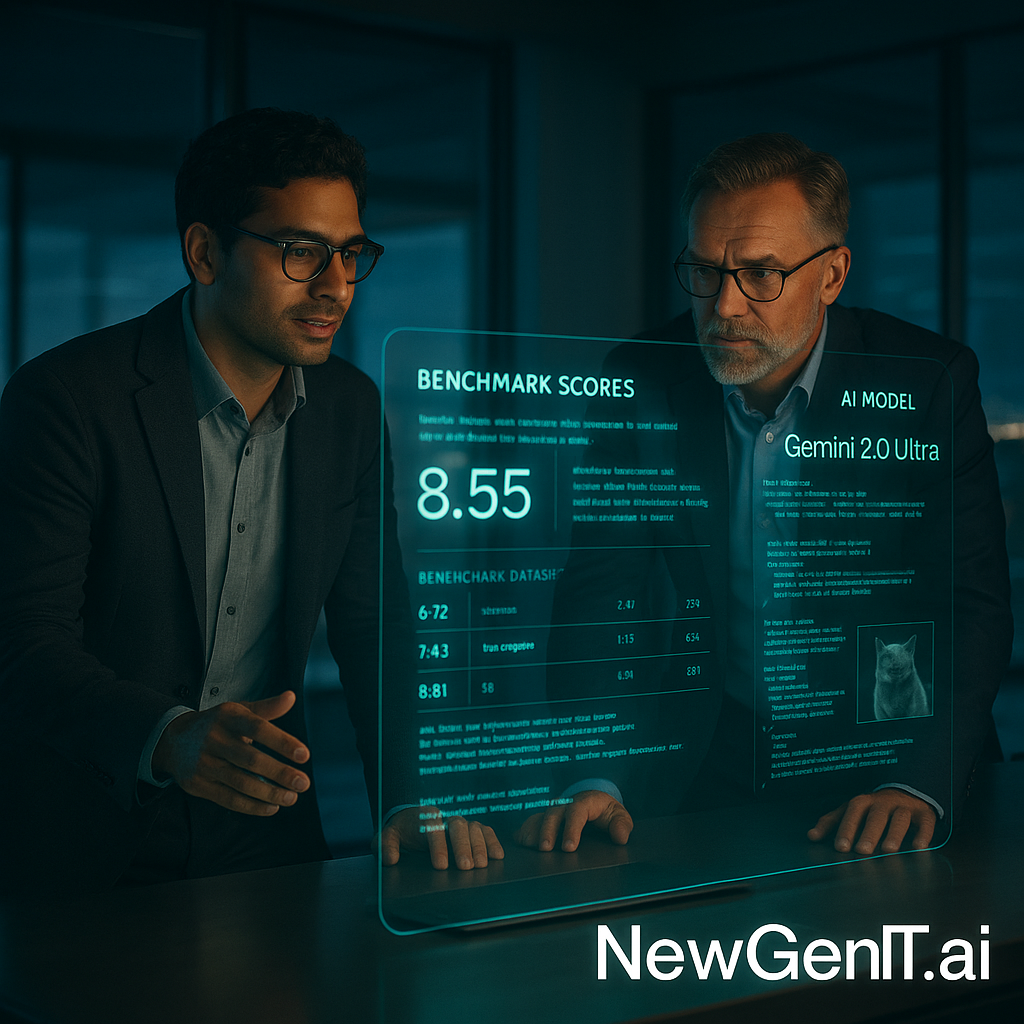
Google’s Gemini 2.0 Ultra has taken the AI world by storm, setting new standards with its outstanding benchmark scores in natural language understanding, reasoning, and multimodal AI tasks. However, for South African enterprises, the question extends beyond raw scores: How does Gemini 2.0 Ultra translate into practical benefits in a complex and constrained local business environment?
Understanding Gemini 2.0 Ultra’s Benchmark Excellence
Benchmark scores, while impressive, often provide a theoretical view of AI capabilities. Gemini 2.0 Ultra’s 8.55 rating on key natural language and reasoning benchmarks indicates it processes, understands, and contextualizes human inputs better than most competing models. This is crucial for South African enterprise AI projects where local languages, diverse data types, and context-rich communication demand nuanced AI understanding.
For instance, in banking hubs like Sandton and Cape Town’s growing fintech scene, AI-powered chatbots must comprehend complex financial queries both formally and colloquially. Gemini 2.0 Ultra’s elevated reasoning ability supports this with better accuracy, reducing failure rates that typically burden customer service teams.
Practical Impact: From Benchmark to Business Use Cases
Enterprises in South Africa face pressing challenges such as diverse customer demographics, varying literacy levels, and infrastructure limitations exacerbated by intermittent load-shedding. Gemini 2.0 Ultra supports multimodal inputs, meaning it can efficiently combine text, image, and code data in real time.
Consider retail and e-commerce platforms in Durban implementing AI-driven personalization. Gemini 2.0 Ultra enables smarter recommendation engines by analyzing product images along with customer reviews and interaction histories. The result: more relevant offers that improve conversion rates, directly impacting revenue in rand.
Similarly, in the healthcare sector, which is digitizing records under national regulations, Gemini’s improved contextual understanding helps parse unstructured notes and visual images more accurately, boosting diagnostics support and patient outcomes.
Efficiency and Scalability in the South African Context
Efficiency and scalability are critical when deploying AI in environments with frequent power disruptions and constrained IT budgets. Gemini 2.0 Ultra’s architecture is optimized to reduce latency and compute costs, which means enterprises can scale AI applications without a proportionate rise in infrastructure expenditure, vital in the rand-sensitive market.
For South African cloud providers and data centres, Gemini’s model supports hybrid cloud deployments, allowing businesses to keep sensitive workloads on-premise for POPIA compliance while leveraging cloud flexibility. This hybrid approach is essential for sectors like financial services where data residency and security are not just regulatory boxes but reputation imperatives.
Compliance and Security: POIPIA Alignment and Beyond
POPIA (Protection of Personal Information Act) governs how South African enterprises handle personal data, making AI adoption complex due to privacy and data sovereignty concerns. Gemini 2.0 Ultra’s design integrates security features to ensure data encryption and access controls align with these regulations.
Moreover, Gemini’s efficient processing reduces exposure by minimizing data transmission and storage needs, supporting decentralized AI inference close to the data source, which helps enterprises comply with POIPIA while still leveraging AI’s power.
Integrating Gemini 2.0 Ultra into Enterprise AI Strategies
For CTOs and solution architects based in Johannesburg, Durban, or Cape Town, Gemini 2.0 Ultra offers a path to unlock AI’s full value by evaluating beyond benchmarks. Real enterprise impact requires:
- Assessment of AI model integration: Evaluating how Gemini fits with existing data infrastructure and legacy systems.
- Proof of concept with measurable KPIs: Setting realistic goals such as reducing customer query resolution time or increasing sales conversion through AI-driven personalization.
- Considering operational resilience: Architecting AI workflows with built-in redundancy to withstand load-shedding.
- Ensuring compliance: Partnering with legal and compliance teams to guarantee AI usage adheres to POIPIA requirements.
These approaches ensure Gemini 2.0 Ultra is leveraged not merely as a benchmark winner but as a reliable technology enabler.
Examples of Industry-Specific Applications in South Africa
Several local examples illustrate Gemini's potential:
- Financial Services: Prominent banks in Sandton are piloting Gemini-based analytics to flag fraudulent transactions by combining textual transaction data with image inputs from mobile deposits.
- Retail and E-commerce: Cape Town-based retailers are improving customer engagement through AI chat assistants capable of understanding both Afrikaans and indigenous languages contextually.
- Healthcare: Durban clinics use AI-powered diagnostics assistants to analyze radiology images alongside patient notes ensuring faster, more accurate diagnoses.
In each case, Gemini 2.0 Ultra's scalability and nuanced understanding deliver clear operational advantages and cost efficiencies in rand.
Next Steps for South African Enterprise AI Leaders
Adopting advanced AI models like Gemini 2.0 Ultra requires clear strategic vision. South African organisations should:
- Engage with AI technology partners who understand local market constraints and compliance needs.
- Invest in pilot projects focusing on high-impact AI applications aligned with business goals.
- Train in-house AI engineering teams to optimise and manage scalable AI deployments.
- Prepare infrastructure for seamless integration of multimodal AI capabilities despite load-shedding challenges.
By approaching AI with operational pragmatism and a focus on local conditions, enterprises can harness Gemini 2.0 Ultra’s capabilities to drive meaningful competitive advantages.
Discussion
As South African enterprises explore Gemini 2.0 Ultra, what practical challenges and opportunities do you foresee in integrating these benchmark-leading AI models into your AI strategies? How do you balance the technical promise with regulatory and infrastructural realities? Share your thoughts and experiences.