
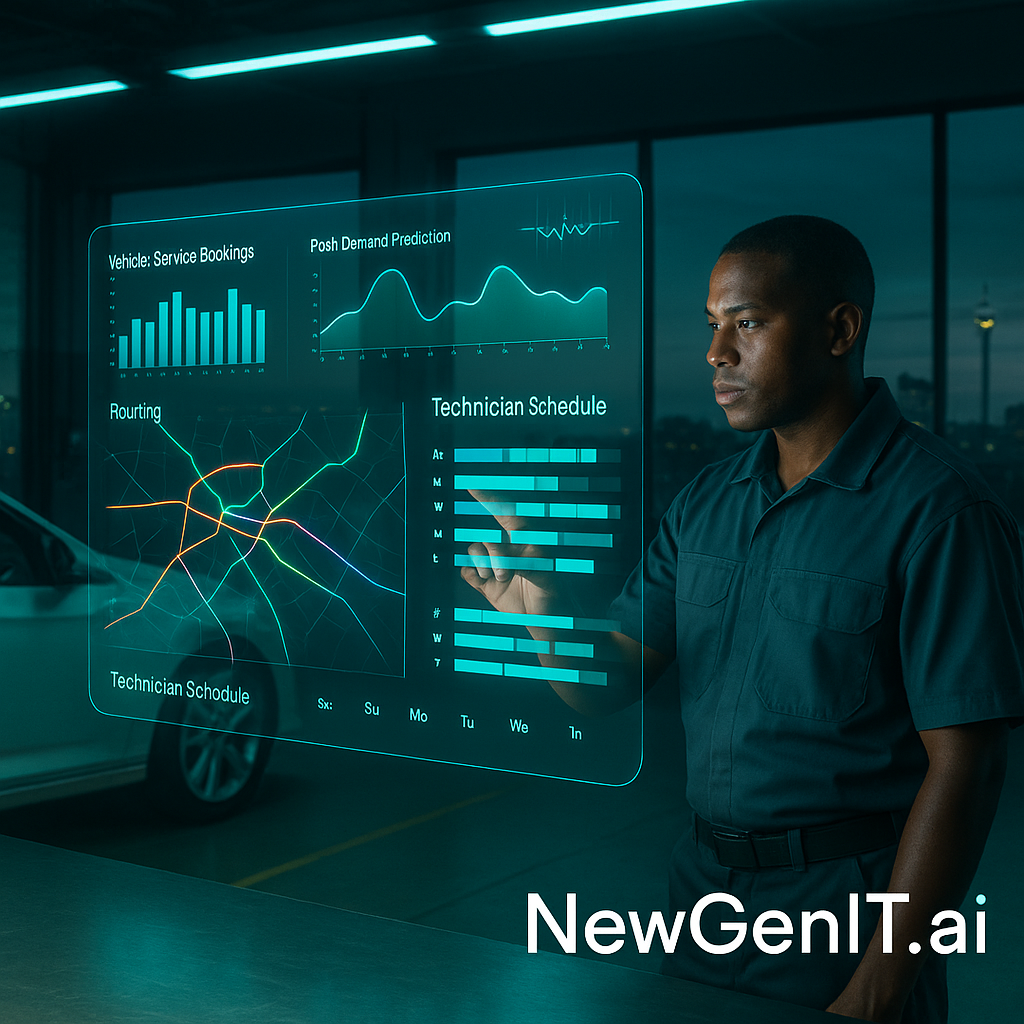
Walk into any busy automotive dealership service department on a Monday morning in Johannesburg and you'll witness a peculiar kind of controlled chaos. The service advisor is juggling a phone that won't stop ringing, a queue of customers who all arrived at 8am, technicians standing idle waiting for parts, and a booking system that promised nine cars could be serviced today when the realistic number is closer to six. Somewhere in that mess sits a real, measurable revenue leak , and for most dealerships, it's been leaking for years.
The problem isn't a lack of software. Nearly every dealer group in South Africa runs a dealer management system (DMS) of some sort. The problem is that these systems are static. They record bookings; they don't optimise them. They tell you what happened; they don't help you decide what to do next. That gap , between recording and deciding , is exactly where Forward Deployed AI earns its keep.
What "Forward Deployed" Actually Means
Let's clear up the jargon first, because "Forward Deployed AI" gets thrown around loosely. It doesn't mean bolting a chatbot onto your website or piping your data off to some generic model in a data centre in Frankfurt and hoping for the best.
Forward Deployed AI means embedding the model , and, crucially, the engineers who build and tune it , directly inside the operational workflow of the business. The AI lives where the decisions are made: in the service booking flow, in the technician scheduling logic, in the parts availability check. It's context-aware because it's built with the messy reality of that specific dealership in mind, not an abstracted average of dealerships worldwide.
For a South African dealer, that context matters more than most people appreciate. A model trained on European service patterns has no concept of load-shedding wiping out a Tuesday afternoon's diagnostic bay, or of the way month-end paydays cluster service bookings, or of the fact that a parts shipment can sit at customs for an extra week. Forward Deployed AI is built to understand those local subtleties , because it's built next to them.
The Three Places AI Delivers Real Money
There's a temptation to sprinkle AI everywhere. Resist it. In automotive service operations, three areas deliver disproportionate returns.
1. Demand-Aware Booking
Most booking systems treat every day the same. In reality, demand is wildly uneven. School holidays, month-end, the days after a long weekend when everyone's back from a Drakensberg road trip , these all spike differently. A demand-aware model looks at your historical booking data, seasonal patterns, and even external signals like local event calendars to predict which slots will be under pressure and which will sit empty.
The practical result: instead of first-come-first-served, the system can steer flexible customers toward quieter slots, hold capacity for high-value work, and stop over-promising on days that were always going to fall apart.
2. Intelligent Routing and Technician Assignment
Not all technicians are interchangeable. A master tech on a complex electrical diagnosis is worth three apprentices, and putting the wrong person on the wrong job is how you get comebacks. AI-driven routing matches the job's complexity to the technician's skill, accounts for who's already loaded, and sequences work to minimise idle time between jobs.
Extend this to customer vehicle collection and delivery , a growing expectation in the premium segment , and routing across Johannesburg or Cape Town traffic becomes a genuine optimisation problem. Get it right and you shave hours off your daily operation while lifting your first-time fix rate, which is the single metric customers actually feel.
3. Adaptive Capacity Planning
Capacity planning in most dealerships is a spreadsheet someone updates once a quarter. It's hopelessly out of date the moment reality changes. An adaptive model continuously factors in parts lead times, staff availability, and even regional traffic and weather patterns to give you an honest, live view of what you can realistically take on.
The dealerships that win aren't the ones with the most bays. They're the ones who know, at any given moment, exactly how much work they can actually deliver , and price and book accordingly.
The Numbers, and Why They're Believable
Implementations across automotive service networks have shown Forward Deployed AI models reducing booking mismanagement by up to 30% and driving meaningful improvements in technician utilisation. Those figures sound impressive, but the reason they're believable is simpler than the AI itself.
A dealership running at 65% technician utilisation is paying full salaries for people who are productive two-thirds of the time. Lifting that to 80% doesn't require magic , it requires knowing which jobs to slot where and when, in real time, without a human trying to hold the whole puzzle in their head. That's a scheduling and prediction problem, and it's exactly the kind of problem machine learning is genuinely good at.
In rand terms, for a mid-sized dealership, a 15-point utilisation improvement and a reduction in comebacks can translate into a six-figure annual swing , before you even count the revenue from customers who stay loyal because their car was ready when promised.
Building It Right: The POPIA and Infrastructure Reality
None of this happens in a vacuum. Two South African realities shape how these systems must be built.
First, POPIA. Customer vehicle records, contact details, and service histories are personal information. A model that ingests this data needs proper consent handling, purpose limitation, and , ideally , architecture that keeps sensitive data processing local rather than shipping it offshore. Forward Deployed AI actually helps here: when the model runs close to the source, you have far tighter control over where data goes and who touches it.
Second, infrastructure resilience. Any system that depends on a permanent, high-bandwidth connection to a remote data centre will fail you during load-shedding and connectivity drops. Systems designed to run edge-side or with graceful offline fallback keep the service department moving even when the grid doesn't. This isn't a nice-to-have in South Africa , it's a design requirement.
What This Means for Engineers
For the engineers building these systems, forward deployment is a genuine shift in mindset. You're not delivering a model and walking away. You're sitting inside the business, watching how the service advisor actually uses the tool, seeing where the model's predictions rub against operational reality, and tuning continuously.
That proximity produces better systems. When you can see that the model keeps under-estimating capacity on rainy Fridays, you fix it. When you notice the routing logic ignores that one bay that can't take double-cab bakkies, you catch it before it becomes a customer complaint. This is context that no amount of remote data analysis surfaces cleanly. Deploying close to the decision means your systems become responsive, adaptive, and grounded in how the business genuinely runs.
The Takeaways
- The value isn't in AI, it's in decisions. Your DMS records; Forward Deployed AI decides. Focus on the three high-return areas , demand-aware booking, intelligent routing, and adaptive capacity , before anything else.
- Local context is the whole point. Load-shedding, month-end demand spikes, customs delays, and regional traffic are not edge cases in South Africa. Build for them, don't average them away.
- POPIA compliance and offline resilience are design requirements, not afterthoughts. Forward deployment makes both easier by keeping data and processing close to home.
- The ROI is concrete. Utilisation gains and fewer comebacks translate directly into rand , and into the customer loyalty that keeps a dealership alive.
- Engineers belong in the operation, not remote from it. The best models are tuned by people who've watched the service department at 8am on a Monday.
South African dealerships already have the data, the pain points, and the margin pressure to make this worthwhile. What's usually missing is an AI capability deployed close enough to the operation to actually understand it. That's the gap worth closing.
How are you leveraging AI in your automotive operations? We'd genuinely like to hear how you're thinking about deploying models directly inside business workflows , and where you're seeing the measurable gains.