
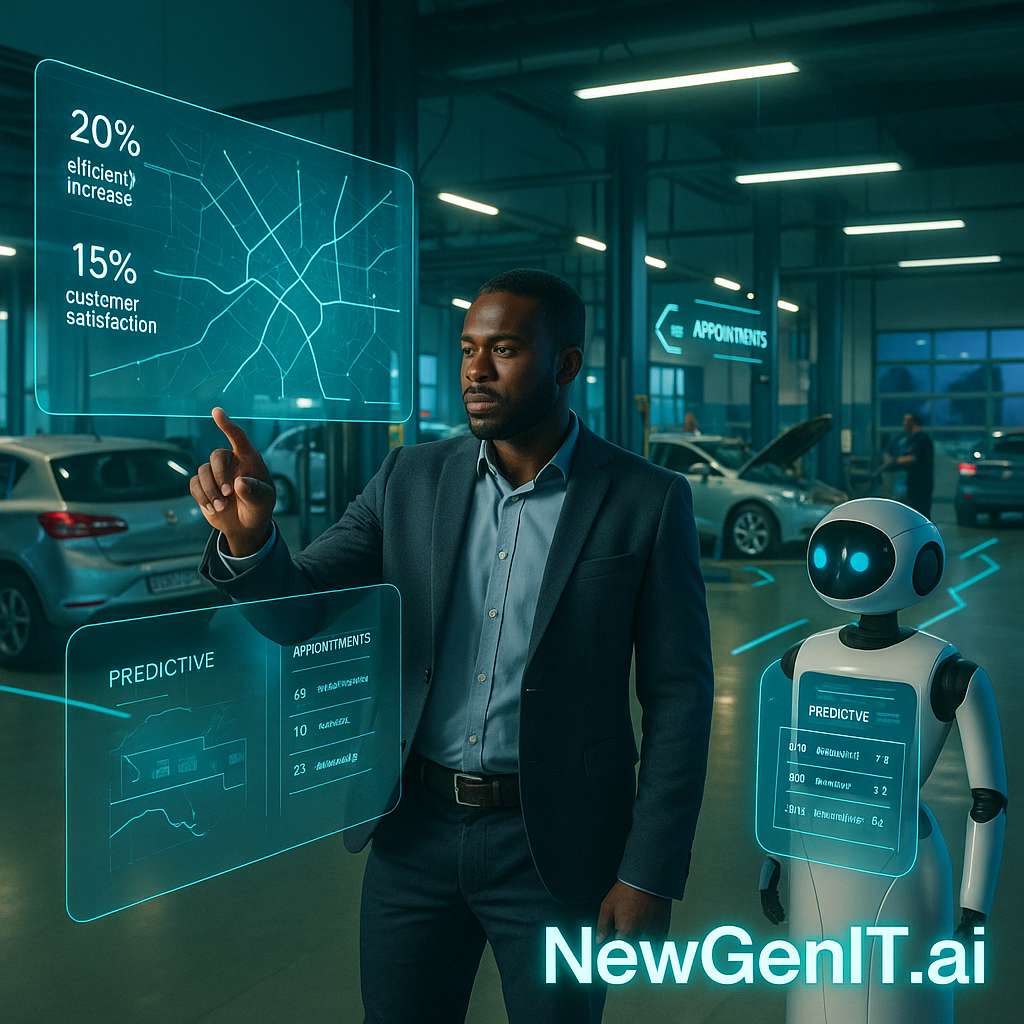
Walk into almost any franchised dealership service department in Johannesburg or Cape Town on a Monday morning and you'll see the same picture: a queue of frustrated customers at the service desk, a service advisor juggling three phone calls, a workshop that's either dead quiet or hopelessly overbooked, and a courtesy shuttle stuck somewhere on the N1. The scheduling was done last week. The reality is happening now. And the gap between those two things is where dealerships bleed money and goodwill.
This is exactly the kind of problem Forward Deployed AI (FDAI) was built to solve. Not the glossy, boardroom-slide version of AI that produces a quarterly report nobody reads, but AI that sits inside your operations, makes decisions in real time, and adapts when a technician calls in sick or three walk-ins arrive before 9am.
What "Forward Deployed" Actually Means
The term matters, so let's be precise. Most AI you've encountered is centralised and analytical , you feed it historical data, it produces insights, someone interprets those insights, and eventually a human makes a decision days or weeks later. It's a consultant that lives far from the shop floor.
Forward Deployed AI flips that. The intelligence is embedded directly into the operational workflow. It's not producing a report about your booking patterns , it's actively deciding which technician gets which job, when to slot a walk-in, and whether the 14:00 diagnostic can realistically be finished before closing. It's a member of the team, not an observer of it.
The difference between analytical AI and Forward Deployed AI is the difference between a weather report and a co-pilot who adjusts your route mid-flight.
For a South African dealership, this distinction is not academic. Our operating conditions change hour to hour in ways that a weekly forecast can never capture.
The Local Constraints That Make This Hard , and Necessary
Automotive AI solutions built in Munich or Detroit assume a set of conditions that simply don't hold here. Any engineer deploying FDAI in South Africa has to design around a specific set of realities:
- Load-shedding. A workshop running on Stage 4 has fundamentally different capacity than one on full grid power. Diagnostic equipment, hoists, and paint booths may be offline for blocks of the day. An FDAI system that doesn't ingest the Eskom loadshedding schedule and adjust bookings accordingly is going to promise turnaround times it can't keep.
- Traffic and geography. Routing a mobile technician or a parts runner from Sandton to Midrand at 07:30 is a completely different problem than doing it at 11:00. Our congestion patterns are severe and predictable enough that geospatial optimisation delivers real, measurable savings , but only if the model is fed live and historical traffic data specific to local corridors.
- Parts availability and rand volatility. Import-dependent parts supply and currency swings mean lead times fluctuate. Scheduling a service for a vehicle that needs a back-ordered component is a booking that shouldn't have been accepted in the first place.
- Data quality. Many dealership management systems (DMS) here are aging, and service histories are often incomplete or inconsistently captured. This is the single biggest engineering challenge , the AI is only as good as the data it can reach.
These constraints are precisely why generic, off-the-shelf scheduling software underperforms locally. FDAI's value lies in adapting to your operating environment rather than forcing your operation into someone else's assumptions.
How It Works in Practice
Let's get concrete about what an embedded system actually does across a dealership's service operation.
Predictive booking and capacity planning
By analysing years of historical booking data, the model learns your genuine demand patterns , the Monday spike, the month-end quiet period, the surge before the December holidays when everyone suddenly wants their car serviced before the coastal drive. Instead of a flat booking grid, the system dynamically shapes capacity: reserving slots for anticipated walk-ins, spacing out complex jobs so the workshop doesn't choke, and warning the service manager when the day is being overbooked relative to available technician-hours.
Dynamic technician and job routing
Not every technician can do every job. A master tech handling a gearbox rebuild shouldn't be assigned an oil service. FDAI matches jobs to skills, current workload, and estimated completion times, then re-optimises the whole queue when reality intervenes , a job runs long, a part is missing, a customer arrives early. For dealerships running mobile service or multiple branches, the same engine handles vehicle routing across the real road network.
Turnaround and communication
Because the system holds a live model of the workshop, it can give customers realistic ETAs rather than optimistic guesses , and update them proactively when things change. In an industry where "I'll phone you when it's ready" is the default and the phone rarely rings, that alone shifts customer perception.
The Numbers, and How to Read Them
Industry reporting suggests dealerships adopting Forward Deployed AI see up to a 20% improvement in service efficiency and a 15% rise in customer satisfaction scores. Those are strong figures, but treat them as a ceiling under good conditions rather than a guarantee.
Where does that efficiency actually come from? It's the compound effect of small wins: fewer idle technician-minutes between jobs, less rework from mismatched skills, fewer wasted trips for mobile teams, and higher bay utilisation because capacity is planned against real demand. On the customer side, the satisfaction lift comes almost entirely from accurate expectations , people forgive a longer wait far more readily than a broken promise.
The honest caveat: these gains are only realisable if the underlying data pipeline is sound. A dealership with a well-maintained DMS and disciplined job-card capture will hit the top of that range. One where service advisors free-type job descriptions and half the mileage fields are blank will need to fix its data foundation first. That's not a reason to delay , it's the first phase of the project.
POPIA and the Data You're Touching
Any FDAI deployment in South Africa is processing personal information , customer names, contact details, vehicle registrations, service histories, and location data if mobile services are involved. That puts the entire system squarely under the Protection of Personal Information Act.
Engineers building these systems need to bake in compliance from the design stage, not bolt it on afterward:
- Purpose limitation , use the booking and vehicle data only for the operational purposes the customer would reasonably expect.
- Data minimisation , the routing engine needs a location, not a life story. Don't ingest fields the model doesn't need.
- Security safeguards , encryption in transit and at rest, proper access controls, and audit logging, especially where data leaves the dealership's own systems for cloud processing.
- Accountability , a clear record of what the AI decides and why, which matters both for POPIA and for the service manager who needs to trust and occasionally override the system.
Handled well, POPIA compliance becomes a selling point rather than a burden , customers are increasingly aware of how their data is used, and a dealership that can speak to it confidently earns trust.
Takeaways for Engineers and Dealer Principals
If you're weighing up Forward Deployed AI for an automotive operation, here's where to focus:
- Fix the data first, or fix it in phase one. The quality of your DMS data sets the ceiling on everything else. This is the real work, and it's unglamorous.
- Model your actual constraints. Load-shedding schedules, local traffic corridors, technician skill matrices, and parts lead times aren't edge cases here , they're the core of the problem.
- Design for override. The best FDAI systems keep a human service manager in the loop and earn their trust over time. An AI that can't be overridden won't be adopted.
- Treat POPIA as an architecture requirement, not a legal afterthought.
- Measure honestly. Track bay utilisation, promise-versus-actual turnaround, and rebooking rates , not vanity metrics.
Forward Deployed AI isn't a distant analytical tool that hands you a dashboard. Done right, it's an embedded operations partner that makes better decisions than a manual system can, at a pace no human coordinator could match , and it does so in a way that respects the messy, load-shed, congested, rand-volatile reality of running a dealership in South Africa.
How are you thinking about integrating AI into your service operations? And what's your biggest obstacle , the data, the infrastructure, or the change management? We'd genuinely like to hear where you're stuck.