Ask any South African who has filed an insurance claim after a smash-and-grab, a burst geyser, or a hailstorm that turned their car's roof into a golf ball, and you'll hear the same story: the incident was stressful, but the claims process was worse. Forms in triplicate. Documents emailed into a void. Days of silence, then a request for the exact same document you already sent. By the time the payout lands, the customer's loyalty is already gone.
This is the real battleground in insurance today. Premiums are commoditised, cover is broadly comparable across insurers, and price wars have a floor. The one thing that genuinely differentiates a carrier is the experience at the moment of truth , the claim. That's where Full Digital Experience (FDE), with AI embedded into triage, documentation, and client operations, is quietly rewriting the rules.
Why the Claims Moment Decides Everything
Insurance is one of the few products you buy hoping never to use. For years, the customer relationship runs on autopilot , a debit order goes off, a renewal letter arrives, nobody thinks much about it. Then something goes wrong, and suddenly the entire value of years of premiums is judged in a matter of days.
Get it right, and you have a customer for life who tells their neighbours. Get it wrong, and you've handed a lead to a competitor and possibly earned a one-star review that never disappears from Hellopeter.
McKinsey research suggests that insurers deploying AI across their digital experience see up to 30% higher customer satisfaction alongside meaningful operational efficiency gains. Those aren't just vanity numbers , in a market where retention drives profitability, a few points of satisfaction translate directly into lower churn and lower acquisition spend.
AI-Driven Triage: Sorting the Urgent from the Routine
Not every claim is equal, yet traditional systems often treat them as if they were. A total-loss vehicle write-off after a fatal accident and a cracked windscreen both join the same queue, wait the same amount of time, and get assigned in the same order they arrived.
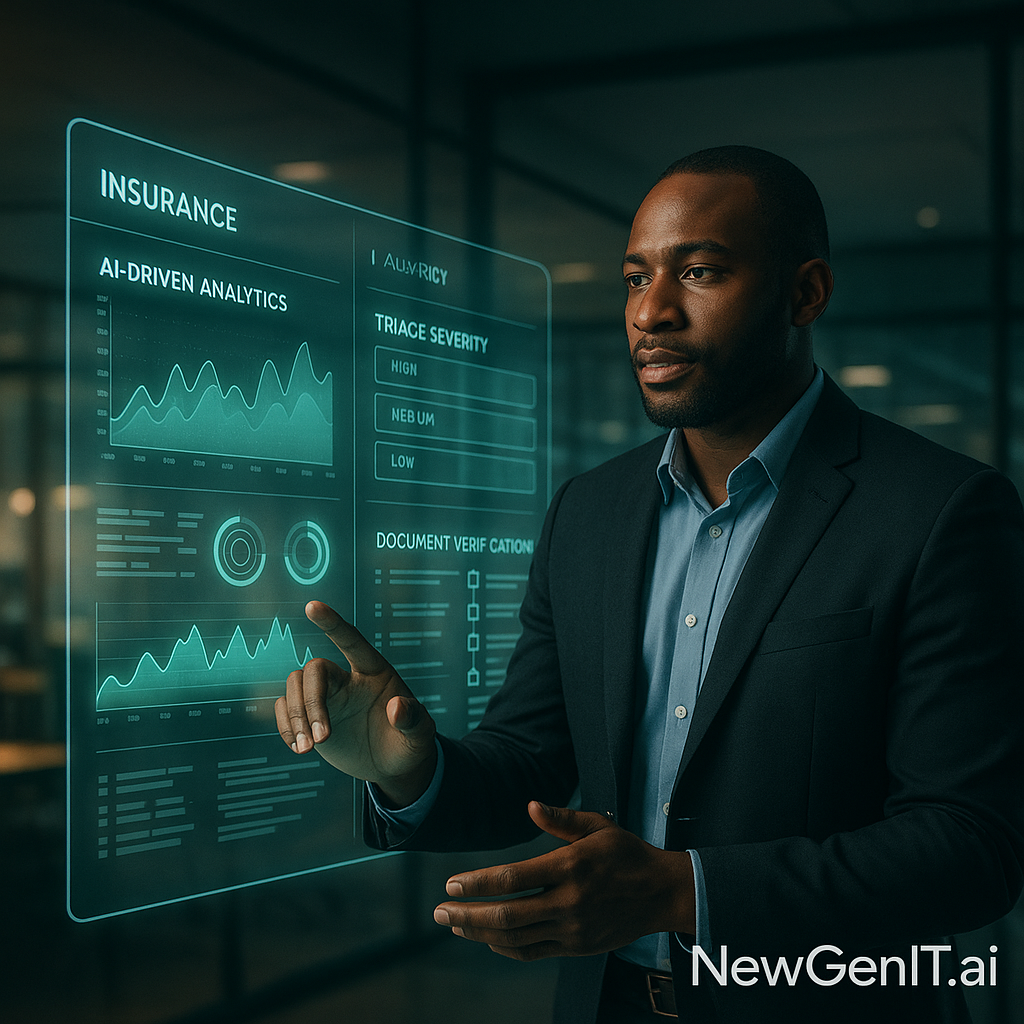
AI-driven triage changes this. The moment a claim comes in , whether through an app, a WhatsApp bot, or a call centre , the system assesses severity, complexity, and urgency in real time. It can:
- Route high-severity claims straight to senior assessors instead of letting them sit in a general pool
- Fast-track low-complexity claims that meet clear criteria for straight-through processing
- Flag potential fraud for investigation before payout, rather than after the money is gone
- Predict likely settlement values to help reserve accurately from day one
In the South African context, this matters enormously during catastrophe events. When a single hailstorm in Gauteng generates thousands of motor claims in one afternoon, or KZN floods swamp an insurer with property claims, manual triage collapses. AI triage keeps the queue intelligent under pressure, ensuring the family whose home is uninhabitable gets seen before someone reporting a scratched bumper.
Intelligent Documentation: Killing the Paperwork Death Spiral
The most common reason claims stall isn't the insurer being difficult , it's incomplete or unreadable documentation. A blurry photo of an ID, a police case number transposed incorrectly, a quote that's missing a signature. Each gap triggers another round of back-and-forth, and each round adds days.
AI-powered documentation tools attack this directly. Using optical character recognition and intelligent extraction, they can read a photographed accident report, pull the case number, cross-check it, and populate the claim file automatically. They verify that a proof of ownership matches the policyholder, that a repair quote falls within expected ranges, and that all required documents are present before the claim moves forward.
The goal isn't to remove humans from the process , it's to remove the tedium so humans can focus on judgement, empathy, and the genuinely complex cases.
There's a serious compliance dimension here too. Under POPIA, insurers are handling some of the most sensitive personal data imaginable , ID numbers, medical records, financial details, home addresses. Manual documentation processes, with documents forwarded over email and stored in shared inboxes, are a data breach waiting to happen. A well-architected AI documentation pipeline can enforce data minimisation, mask sensitive fields, maintain audit trails, and ensure information is processed only for its stated purpose. Done properly, automation isn't a POPIA risk , it's a POPIA safeguard.
AI in Client Operations: Support That Actually Supports
The third pillar is what happens between triage and settlement , the ongoing conversation with the customer. This is where most insurers lose people, because silence feels like neglect. A customer who hasn't heard anything for four days assumes their claim is stuck, even if it's progressing normally.
AI embedded in client operations closes that gap. It provides proactive, real-time updates: "Your assessor has been assigned," "Your quote has been approved," "Payment will reflect within 48 hours." It answers routine questions instantly at any hour , critical in a country where load-shedding might have your customer sitting in the dark at 8pm with nothing to do but worry about their claim.
Crucially, good AI knows its limits. It handles the volume of simple, repetitive queries so that when a customer genuinely needs a human , because they're distressed, because the case is unusual, because they're on the edge of leaving , a person is available and free to give them full attention. The technology should make your best consultants more available, not replace them.
Getting It Right in the South African Market
None of this works as a bolt-on. The insurers seeing real results aren't the ones who bought an "AI claims tool" and switched it on. They're the ones who treated it as an engineering problem , integrating AI into their actual systems, their actual data, and their actual regulatory obligations. This is the difference between a demo and a deployment.
A few practical realities for the local landscape:
- Language and channel diversity matter. Your customers communicate across WhatsApp, USSD, call centres, and apps, in multiple languages. AI systems must meet people where they already are, not force them onto a new platform.
- Infrastructure can't be assumed. Load-shedding, patchy connectivity, and data cost sensitivity mean systems need to be resilient and lightweight, with offline-tolerant design where possible.
- POPIA compliance is non-negotiable. Any AI touching claims data must be built with privacy, consent, and auditability from the ground up , not retrofitted after a regulator comes knocking.
- Trust is fragile. South African consumers are rightly sceptical of automation that feels like a runaround. Transparency about when they're talking to AI versus a person builds trust rather than eroding it.
The Takeaways
The insurers who win the next decade won't be the ones with the cleverest advertising or the lowest premiums. They'll be the ones who made the worst day of their customer's year a little less awful.
To get there:
- Treat the claim as the product. It's the moment your entire brand promise is tested , invest accordingly.
- Use AI triage to be smart under pressure, especially during catastrophe surges that would otherwise overwhelm manual queues.
- Automate documentation to kill the back-and-forth that stalls claims , and use it to strengthen POPIA compliance, not weaken it.
- Deploy AI in client operations to end the silence, while keeping humans available for the moments that truly need them.
- Engineer, don't just purchase. Real gains come from deep integration into your systems and your regulatory context, not off-the-shelf plug-ins.
The technology is ready. The question is whether your operations, your data, and your teams are set up to use it well. At NewGenIT.ai, that's exactly the kind of problem we deploy engineers to solve , embedding AI into the workflows where it actually moves the needle.
How is your organisation integrating AI into claims and client operations? The insurers pulling ahead are the ones treating this as an engineering challenge, not a shopping exercise , and the gap is widening.