
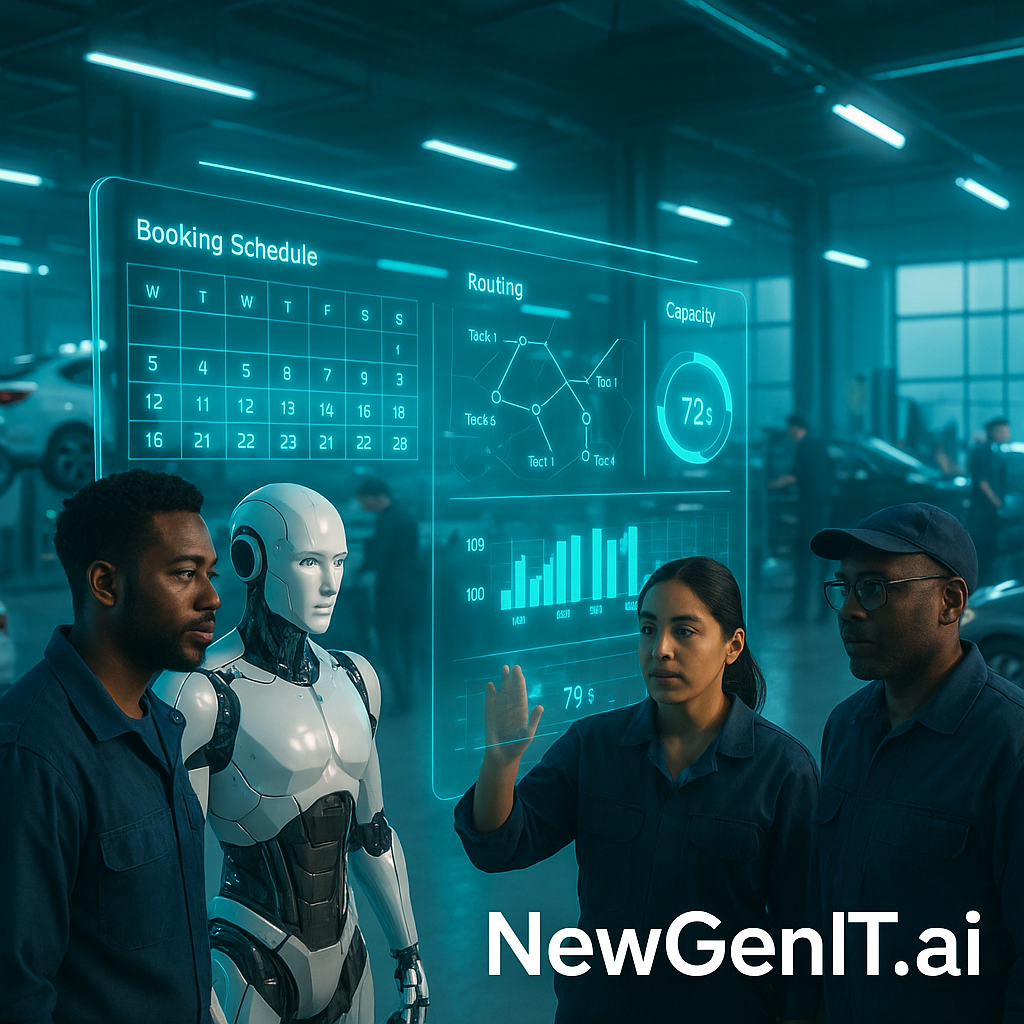
The South African automotive industry stands at a pivotal moment, with forward deployed artificial intelligence (AI) set to redefine how dealerships manage operations. Industry leaders, engineers, and business decision-makers in hubs like Sandton, Durban, and Cape Town must understand how this technology can streamline appointment bookings, optimize service routing, and improve capacity management , thereby elevating operational efficiency and customer satisfaction amidst local challenges.
Understanding Forward Deployed AI in South African Dealerships
Forward deployed AI refers to models that are embedded directly into operational systems at the point of service, enabling real-time, automated decision-making based on live data. Unlike traditional AI models which analyze data offline or post-event, forward deployed AI reacts instantly to dynamics within a dealership, such as technician availability, expected service durations, and customer preferences. This immediacy is critical in a South African context where operational disruptions related to load-shedding can cause unpredictable workflow changes.
For example, a dealership in Durban facing an unscheduled power cut might have limited technician availability and a backlog of vehicle services. A forward deployed AI system could instantly adjust the booking schedule, re-route technicians, and optimize parts delivery to maintain throughput with minimal disruption. This goes beyond static scheduling and reactive management, enabling more resilient operations aligned with real-time realities.
Optimizing Bookings: Reducing Wait Times and Increasing Throughput
Bookings represent the frontline of customer interaction and operational efficiency. In South Africa, where customer expectations continue rising alongside digital adoption, dealerships must book appointments that minimize wait times without overbooking.
Forward deployed AI achieves this by analyzing factors such as:
- Staff availability, factoring in attendance variability and skill sets.
- Predicted service times using historical and current vehicle service data.
- Customer preferences including preferred time slots and service types.
- External factors like public holidays, traffic patterns in major metros like Johannesburg or Cape Town, and anticipated load-shedding schedules.
By integrating these data points, AI dynamically adjusts booking schedules. For instance, a Sandton dealership could reduce average customer wait times from 45 minutes to less than 20 minutes, improving customer satisfaction and increasing the number of service bookings per day by up to 15% , a significant boost to profitability when the rand value per service visit averages around ZAR 3,000.
Routing Optimization: Enhancing Service Logistics and Reducing Downtime
Service routing involves managing technician assignments, parts deliveries, and vehicle movements within the dealership and to offsite locations. Forward deployed AI optimizes routing by:
- Assigning technicians based on skill level, workload, and proximity to service bays.
- Improving parts delivery schedules to prevent bottlenecks, considering stock availability and supplier lead times.
- Minimizing downtime by dynamically re-routing technicians to priority tasks when delays or cancellations occur.
Consider a Cape Town dealership grappling with supply chain delays due to port congestion and local traffic congestion. AI-driven routing can preemptively alter part delivery schedules and reallocate technician resources accordingly. This smart logistics management reduces downtime by up to 25%, translating to faster vehicle turnaround and better asset utilization.
Capacity Management: Predicting Demand and Allocating Resources
Capacity in a dealership context refers to the maximum number of service appointments, repairs, and sales activities possible without compromising quality or customer experience. Often, capacity planning is manual, based on historical data, and prone to inaccuracies.
Forward deployed AI introduces a predictive, data-driven approach by analysing:
- Seasonal trends such as increased vehicle servicing before holiday periods in South Africa.
- Localized demand spikes due to regional marketing campaigns, or economic shifts in metros like Durban.
- Emergency factors like increased breakdowns during cold winters or after severe weather.
- External load-shedding schedules, enabling proactive adjustment of staffing and booking availability.
By leveraging such insights, dealerships can better allocate human resources, workshop bays, and parts inventory, maintaining service standards while optimizing operational expenditure. For example, a dealership in Johannesburg could reduce idle technician time by up to 30%, yielding operational cost savings potentially exceeding ZAR 500,000 per annum.
Compliance with POPIA: Balancing AI Innovation with Data Privacy
Personal Information Protection and Electronic Documents Act (POPIA) compliance is a critical consideration for South African dealerships implementing AI solutions. Handling sensitive customer data such as booking details, vehicle information, and payment transactions requires strict security and privacy governance.
Forward deployed AI models offer advantages here since the majority of data processing can occur locally within dealership infrastructure, reducing exposure to cloud or third-party data breaches. Engineers must design systems with end-to-end encryption, access controls, and audit logs to ensure data sovereignty aligns with POPIA mandates.
By embedding privacy-by-design principles, dealerships safeguard both customer trust and regulatory compliance while harnessing AI-driven efficiencies.
Case Example: Forward Deployed AI in a Sandton Dealership
A leading dealership in Sandton recently implemented forward deployed AI across their service operations. The AI system seamlessly adjusted booking schedules in real-time, improved routing logistics for its fleet of 20 technicians, and predicted demand spikes during festive periods.
Outcomes over six months included:
- 20% increase in daily service bookings without additional staff.
- 35% reduction in average vehicle turnaround time.
- Significant uplift in customer satisfaction scores, with positive feedback on reduced waiting and more reliable appointments.
- Successful management of service workflows during scheduled load-shedding events, minimizing operational impact.
The dealership also reported ROI in under 12 months, demonstrating that forward deployed AI is not only technologically feasible but economically advantageous in the South African market.
Practical Takeaways for South African IT Leaders and Engineers
- Start with Critical Data Integration: Ensure dealership systems provide real-time input on staffing, bookings, and inventory.
- Design for Resilience: Build AI models that adapt to load-shedding and other operational disruptions common in South Africa.
- Optimize Incrementally: Focus first on optimizing bookings, then expand to routing and capacity management to manage complexity.
- Prioritize POPIA Compliance: Engage legal and cybersecurity teams from project inception to embed privacy safeguards.
- Monitor and Refine: Use dashboards and KPIs to continuously refine AI model performance against business and customer outcomes.
As South Africa’s automotive market continues evolving, forward deployed AI will be a cornerstone technology for dealerships aiming to boost operational excellence and customer loyalty.
Discussion: How is Your Team Leveraging AI to Transform Dealership Operations?
As AI technologies mature, dealerships in South Africa face a unique blend of opportunities and challenges, from digital transformation pressures to infrastructure constraints like load-shedding and POPIA compliance. We invite South African IT leaders, engineers, and business decision-makers to share how their teams are implementing AI for operational improvements in automotive services.
What specific AI applications have you explored, and what outcomes have you seen? What hurdles remain in scaling these innovations? Join the conversation and let’s explore how forward deployed AI can enable smarter, more agile dealership operations across South Africa.