
A claims handler in Johannesburg opens their inbox on a Monday morning to find 200 new submissions. Each one is a mixed bag: scanned ID copies, blurry photos of car damage taken on a cracked phone screen, handwritten accident reports, PDF policy schedules, and the occasional WhatsApp screenshot. Before a single decision can be made, someone has to read all of this, work out what belongs to which claim, extract the relevant details, and route it to the right desk. Multiply that across a week and you understand why claim cycle times in South African insurance stubbornly stay measured in days and weeks rather than hours.
This is exactly the problem that AI-embedded Full Document Extraction (FDE) is built to solve , and it's where a Forward Deployed Engineering approach pays off, because the messy reality of local documents rarely matches the clean demos you see at conferences.
What Full Document Extraction Actually Does
Strip away the jargon and FDE is straightforward: it reads documents the way a skilled human would, then turns the information into structured data a system can act on. The difference is that it does this across thousands of documents at once, at any hour, without getting tired at claim number 187.
A modern FDE pipeline handles three jobs that used to eat up most of a handler's day:
- Classification , figuring out what each document is. Is this a police accident report, a medical certificate, a proof of address, or a repair quote? The system sorts a jumbled upload into named categories automatically.
- Extraction , pulling out the fields that matter. Claim number, policy number, date of loss, ID number, amount claimed, vehicle registration. It reads printed text, handwriting, tables, and even stamps.
- Validation and triage , checking the extracted data against policy records and business rules, then prioritising the queue. A straightforward, fully-documented claim can be fast-tracked; one with missing information or fraud indicators gets flagged for human review.
The "embedded" part is the crucial distinction. Instead of bolting AI onto the side as a separate tool that staff have to remember to use, FDE sits inside the claims workflow. The moment a document lands, it's read, classified, and triaged before a human ever touches it.
Why This Matters More in South Africa Than Elsewhere
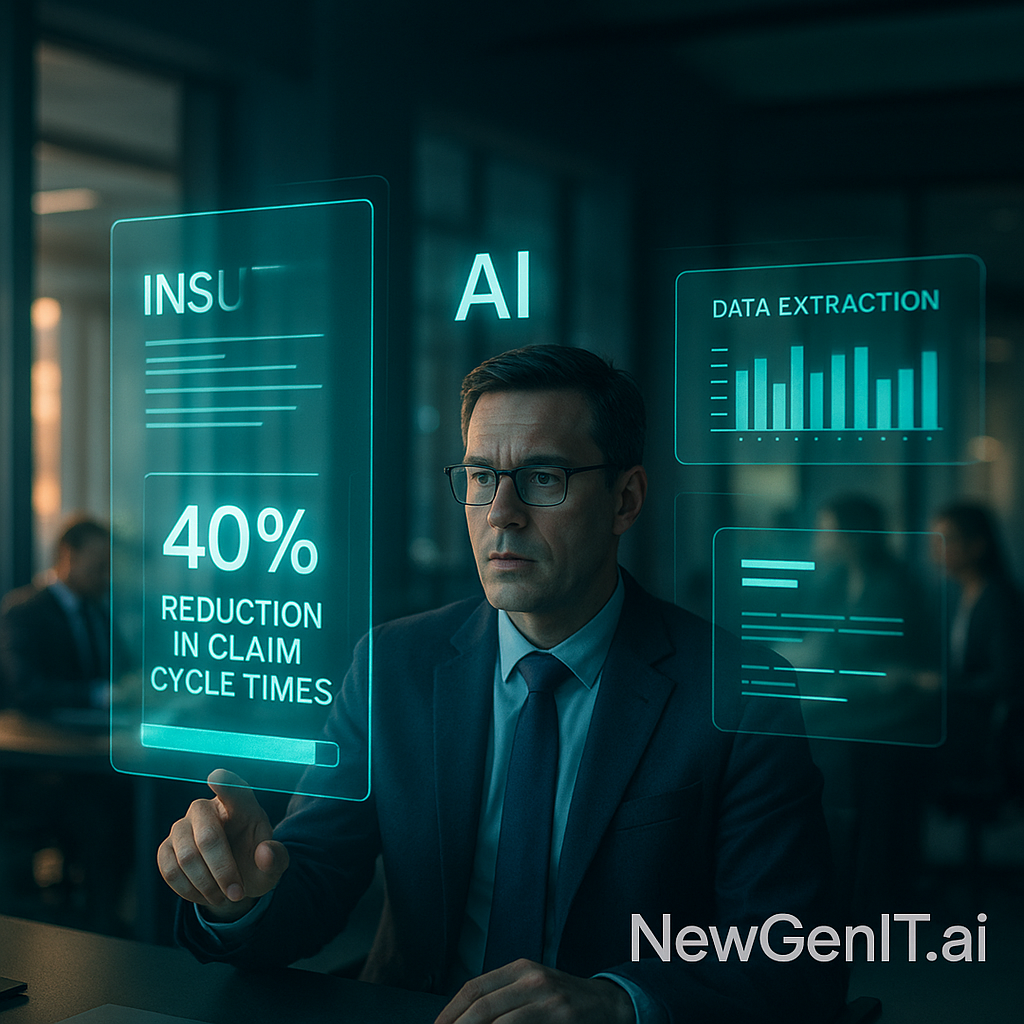
The 40% reduction in claim cycle times that gets quoted in industry reports is real, but the local context makes the case even stronger.
Document diversity is extreme here. A single motor claim might involve an English police report, an Afrikaans-language garage quote, a handwritten witness statement, and a photo of a number plate. International FDE models trained on clean US or European forms fall over on this variety. A forward-deployed approach means the extraction models are tuned on your actual document mix, not a generic template library.
Load-shedding breaks manual processes. When the power goes and staff can't work through their queues, backlogs pile up fast. An AI-embedded pipeline running in the cloud keeps processing documents through the outage, so when your team comes back online they're triaging a prioritised queue rather than digging out from under a mountain.
POPIA raises the stakes on document handling. Claims documents are stuffed with personal information , ID numbers, medical details, banking information. Under the Protection of Personal Information Act, insurers carry real accountability for how that data is processed, stored, and shared. A well-designed FDE system can help here rather than hurt: it can automatically detect and redact personal information, log exactly who accessed what, and enforce retention rules. But this only works if privacy is engineered in from the start, not patched on afterwards.
The goal is not to remove humans from claims. It's to remove humans from the parts of claims that are pure administrative friction , so they can spend their judgement where it actually counts.
The CX Payoff: From Bottleneck to Trust-Builder
For customer experience leaders, the interesting shift isn't the internal efficiency , it's what faster, cleaner documentation does to the customer relationship.
Consider what a policyholder experiences during a claim. They've usually just had a bad day: an accident, a burglary, a burst geyser. What frustrates them most is not the settlement amount , it's the silence. The "we're still reviewing your documents" holding pattern that stretches on with no visibility.
AI-embedded FDE attacks that directly:
- Faster acknowledgement. Because documents are read on arrival, the system can immediately confirm what's been received and, critically, tell the customer what's missing , before a handler has even looked at the file.
- Fewer back-and-forth requests. The single biggest cause of delay is incomplete submissions. Automated extraction catches gaps upfront, so customers aren't asked for the same document three times over three weeks.
- More time for the human conversation. When handlers aren't buried in data capture, they have capacity to actually talk to claimants, explain decisions, and rebuild trust at the exact moment it matters most.
This is the quiet economics of it: every rand you're spending on manual document capture is a rand not spent on the human engagement that drives retention. Given how price-sensitive the South African insurance market is, and how quickly a bad claims experience turns into a churned customer and a public complaint, the CX argument often outweighs the pure cost-saving one.
What Separates a Working System From a Failed Pilot
Plenty of insurers have run AI document projects that never made it out of the pilot phase. The pattern of failure is consistent, and worth naming:
1. Treating it as a technology drop, not a workflow change
The model is the easy part. The hard part is where the extracted data flows, who reviews the flagged cases, and how exceptions are handled. If the AI produces beautiful structured data that then lands in a spreadsheet nobody owns, you've built an expensive novelty. Forward Deployed Engineering means engineers embedding with your claims team to redesign the workflow around the AI, not just handing over a model.
2. Ignoring the confidence threshold
Good FDE doesn't pretend to be right 100% of the time. It attaches a confidence score to every extraction. The design decision that makes or breaks the system is where you set the threshold for automatic processing versus human review. Set it too aggressive and errors slip through; too cautious and you've just built a system that sends everything to a human anyway. This gets tuned against your own risk appetite and real documents.
3. Skipping the audit trail
In a regulated environment, "the AI decided" is not an acceptable answer to a Financial Sector Conduct Authority query or a POPIA complaint. Every extraction, every automated decision, every redaction needs to be logged and explainable. Systems built without this in mind become liabilities the moment they're scrutinised.
Where to Start
You don't need to boil the ocean. The organisations getting real value from AI-embedded FDE tend to follow a sensible sequence:
- Pick one high-volume, high-friction claim type , motor and household are usually the best candidates because the document mix is repetitive enough to measure and improve.
- Instrument your current baseline first. If you don't know your true average cycle time and your rate of repeat document requests today, you can't prove the 40% improvement tomorrow.
- Run humans and AI in parallel initially. Let the system extract and triage while handlers still review, so you build confidence in the accuracy before you start automating the routing.
- Design for POPIA from day one. Redaction, access logging, and retention rules should be in the first build, not version three.
The Takeaway
AI-embedded Full Document Extraction isn't about replacing your claims team with robots. It's about deleting the administrative drudgery that currently stands between a stressed customer and a fast, fair resolution. When the reading, sorting, and checking of documents happens automatically and accurately, your people are freed to do the two things machines can't: exercise judgement on the hard cases, and be human with the people who need it.
The insurers that win the next few years in South Africa won't be the ones with the flashiest AI announcements. They'll be the ones who quietly rebuilt their claims workflow around it , tuned to local documents, compliant with POPIA, and resilient through load-shedding , so that a Monday-morning inbox of 200 mixed submissions becomes a prioritised, mostly-processed queue by the time the coffee's ready.
If your organisation is wrestling with claims backlogs, document chaos, or a CX experience that's slower than your customers deserve, that's exactly the kind of problem worth having a proper conversation about.